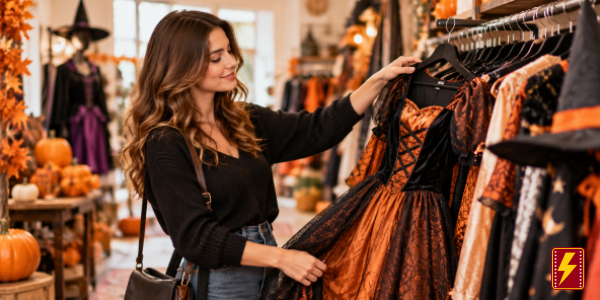
- Choose a Halloween costume retailer by the risk you need to reduce—fit, selection, returns, timing, accessories or budget.
- Use item-specific measurements instead of ordinary clothing size labels because costume sizing varies widely across brands and sellers.
- Check seasonal return deadlines before ordering multiple sizes; some Halloween retailers close returns or switch to exchanges well before October 31.
- Calculate the all-in costume price, including wigs, makeup, props, shoes and shipping, before deciding which store is cheaper.
- For last-minute shopping, prioritize local availability and a simple backup plan over a slightly larger discount.
The best place to buy a Halloween costume depends less on which store has the biggest catalog and more on what could go wrong with your purchase.
If sizing is uncertain, the return window matters. If you need a licensed character, selection matters. If Halloween is three days away, local stock and pickup matter. If the costume is mostly clothing you already own, a specialty costume retailer may not even be the best starting point.
That is the useful way to choose a Halloween costume store: identify the risk first, then pick the retailer that handles that risk best.
Start with the problem you are trying to avoid
Most costume purchases fail for one of six reasons:
- the costume does not fit;
- the quality feels cheaper than expected;
- the character or size sells out;
- shipping arrives too late;
- the return window closes before you decide;
- the costume needs extra accessories that make the final price much higher.
The store that works best for you should reduce the problem that matters most.
Costume shopping in 2026 is starting earlier
Current Halloween research shows that costume wearers increasingly begin shopping before October. The Halloween & Costume Association reports that a majority of costume-wearing adults begin shopping in September or earlier, while only a small share wait until the final two weeks of October.
That matters because early shopping gives you:
- more size choice;
- more time for exchanges;
- more time to compare quality;
- less dependence on expedited shipping;
- more flexibility to switch to DIY if the first idea fails.
Waiting can still work, but the retailer decision changes as Halloween gets closer.
Use a retailer decision map instead of a “best store” ranking
No single store is best for every shopper.
| Your biggest concern | Best retailer type to prioritize |
|---|---|
| Licensed character selection | Specialty Halloween retailer |
| Trying on before buying | Local seasonal or mass retailer |
| Last-minute purchase | Store with local pickup or physical stock |
| Low budget | Mass retailer, discount store or DIY |
| Complex adult costume | Specialty costume retailer |
| Easy returns | Retailer with a clear return window that extends past your try-on date |
| Accessories and makeup | Specialty party/costume store or beauty retailer |
Specialty costume stores are strongest when the costume itself is the priority
Specialty retailers usually make the most sense when you want:
- licensed movie or TV characters;
- coordinated group costumes;
- couples costumes;
- costume-specific wigs;
- props;
- theatrical makeup;
- less common themes.
If the costume idea is already specific, HalloweenCostumes deals at DealsDasher can be useful to compare complete looks. Costumes Heaven promo codes may also be worth checking when you want a dedicated costume seller rather than a general clothing retailer.
Specialty selection can create its own risk: sizing inconsistency
Costumes are not standardized like ordinary clothing.
Different manufacturers can label similar measurements as:
- small;
- medium;
- large;
- one size;
- adult standard;
without those labels meaning the same thing.
Current 2026 sizing research specifically warns that costume sizing varies widely across major retailers and brands. So make sure to look at the exact sizing chart before you buy.
Ignore the size name and read the measurements
For each costume, check:
- chest or bust;
- waist;
- hip;
- inseam;
- garment length;
- height range;
- weight range where provided.
Do not assume your normal clothing size transfers directly to a costume.
Measure a garment that already fits
This is often easier than measuring the body.
For example, if you are buying a robe-style costume, measure a robe or coat you already like and compare:
- shoulder;
- chest;
- sleeve;
- length.
This gives you a practical reference.
Run a full try-on before you remove tags
Do not judge fit by standing still in front of a mirror for thirty seconds.
Try the costume with the shoes, layers and accessories you expect to wear, then:
- sit down;
- walk up and down stairs;
- raise your arms;
- bend at the waist;
- turn your head in the mask or wig;
- check whether zippers and closures stay comfortable.
This matters because Halloween costumes are often worn for several hours, not for one photo. A costume that technically fits but restricts movement can become uncomfortable quickly.
Check visibility, heat and ventilation during the try-on
Masks, full-head pieces and padded costumes can affect:
- peripheral vision;
- hearing;
- heat;
- breathing comfort;
- communication.
If the wearer cannot see stairs clearly or becomes hot after five minutes indoors, adjust the costume before the event rather than assuming it will be fine outside.
Return windows become more important as Halloween gets closer
Seasonal retailers can use shorter return windows than shoppers expect.
Spirit Halloween’s current 2026 policy says seasonal returns and exchanges are limited before Halloween, with returns ending in mid-October and later October becoming exchange-only before sales become final.
Party City’s current seasonal merchandise policy also requires returns before the holiday and within its stated delivery window.
The lesson is simple: do not assume you can buy a costume on October 20, try it at home and return it after Halloween.
Read the return policy before ordering two sizes
Ordering two sizes can reduce fit risk, but it only works when:
- both sizes are returnable;
- the return window is still open;
- return shipping is affordable;
- the costume has not been worn outdoors;
- restricted accessories are not included.
Wigs, makeup and intimate costume items often have stricter return rules
Retailers frequently limit returns on:
- wigs;
- facial hair;
- cosmetics;
- contact lenses;
- prosthetics;
- undergarments;
- some hosiery.
Check those items separately instead of assuming the costume’s general return policy applies.
Mass retailers are strongest when convenience matters
If you are buying for the house in the same trip, our Halloween decorating without the clutter approach helps keep seasonal purchases focused.
A large general retailer can be the better choice when you want:
- simple kids’ costumes;
- basic adult costumes;
- same-day pickup;
- ordinary clothing pieces for DIY;
- easy access to shoes, layers and accessories in the same trip.
The catalog may be smaller than a specialty store, but the purchase can be easier to manage.
Local pickup is worth real money during the final week
If that same trip includes porch supplies, keep the costume purchase separate from your outdoor Halloween decoration plan so urgency does not inflate the cart.
When Halloween is close, shipping certainty can matter more than a small price difference.
A costume that costs $8 more but can be collected today may be better value than one that needs expedited shipping.
Marketplace selection is broad, but seller-level checking matters
Marketplace sites can offer an enormous costume range.
The risk is that listings may come from many different sellers with different:
- sizing;
- quality;
- shipping times;
- return processes;
- product photos.
Check the exact seller and listing, not only the platform name.
Do not buy from the product image alone
For unfamiliar listings, look for:
- customer photos;
- fabric description;
- included pieces;
- size chart;
- seller ratings;
- delivery estimate;
- return terms.
Product photos can make costume fabric look heavier than it is
Many costumes use:
- polyester;
- thin knits;
- printed foam;
- lightweight capes;
- plastic accessories.
Read material information and reviews when structure or warmth matters.
Look at what is included in the costume
A product photo may show:
- boots;
- wig;
- weapon prop;
- hat;
- gloves;
- jewelry;
that are not included in the box.
The final price changes quickly when several pieces must be bought separately.
Use an “all-in costume price” instead of the package price
If the costume is part of a hosted event, compare that total against the rest of the night with our Halloween party budget guide.
| Item | Cost |
|---|---|
| Base costume | |
| Wig | |
| Makeup | |
| Shoes | |
| Prop | |
| Shipping | |
| Total |
This prevents a $35 costume from quietly becoming an $85 costume.
Accessories can create more impact than upgrading the entire costume
If the base outfit is already recognizable, one strong accessory can finish it.
Examples:
- hat;
- gloves;
- prop;
- wig;
- face makeup;
- cape;
- jewelry.
That is often cheaper than replacing the whole outfit with a premium version.
Beauty retailers can be more useful than costume stores for makeup-led looks
If the character depends more on the face than the outfit, our Halloween makeup at home guide is the more useful next step.
Some Halloween ideas rely more on makeup than clothing.
For goth, vampire, glam skeleton or fantasy looks, the main spend may be:
- eyeliner;
- face color;
- lashes;
- nails;
- setting spray.
If you already own the clothing, Beauty Base discount deals can be worth comparing for makeup that will still be useful after Halloween.
DIY can beat every costume retailer when the base clothing already exists
For a full closet-first build, see our DIY Halloween costumes that don’t look last-minute guide.
Before buying a complete costume, look at:
- black clothing;
- white shirt;
- blazer;
- boots;
- dress;
- workwear;
- sports clothing;
- old formalwear.
If most of the silhouette already exists, you may need only one or two costume cues.
The “one-cue rule” keeps DIY costumes from looking accidental
A simple costume becomes recognizable when one visual cue is strong enough.
Examples:
- witch hat;
- vampire cape;
- cowboy hat;
- chef hat;
- specific makeup pattern;
- signature prop.
The rest of the outfit can be ordinary clothing.
Kids’ costumes need movement and layering room
For fit, warmth, visibility and bathroom-access checks, use our kids’ Halloween costume wear test.
For children, check whether the costume allows:
- walking;
- running;
- sitting;
- wearing a jacket underneath;
- using the bathroom easily;
- seeing clearly.
A perfect-looking costume is poor value when the child wants to remove it after ten minutes.
Use ordinary kids’ clothing when the costume needs warmth
A character T-shirt, hoodie or color-matched outfit can sometimes work better than a thin costume when Halloween night is cold.
If clothing is part of the solution, Kids Around coupons can be one option to compare for pieces that can be worn again after Halloween.
Group costumes need the earliest shopping
If a dog or cat is part of the group idea, plan that separately around comfort and stress using our Halloween with pets guide.
Group themes create more points of failure:
- multiple sizes;
- multiple deliveries;
- different budgets;
- different return windows;
- one essential character selling out.
Buy the hardest-to-find costume first.
Couples costumes should not require identical retailers
If one person needs a specialist costume and the other can build theirs from normal clothing, shop separately.
Matching retailer is not important. Matching visual theme is.
Licensed character costumes usually reward earlier buying
Popular characters can sell through specific sizes even when the costume itself remains listed.
Current 2026 trend coverage points to strong interest in gothic and pop-culture looks, including Addams Family themes, witches and current film or TV characters.
Trend information is useful for predicting stock pressure, not for deciding what you personally should wear.
Classic costumes reduce sellout risk
Witches, vampires, ghosts, skeletons and similar themes are easier to recreate across different retailers.
If one store sells out, another version is usually possible.
Trend-led costumes need a reuse test
A very specific 2026 pop-culture costume may have high relevance this year and lower reuse value later.
That can still be worth it.
Just compare:
- one-night value;
- party use;
- photo value;
- future reuse;
- resale.
Quality matters more when you expect to reuse or resell
If you want more than one night from the costume, look closely at:
- seam strength;
- zip quality;
- elastic;
- fasteners;
- wash instructions;
- whether accessories can be packed without breaking.
A slightly more expensive costume can be better value when it survives another party, next Halloween or resale.
Store the costume with every essential piece together
If you plan to reuse it, keep the:
- belt;
- gloves;
- hat;
- prop;
- wig cap;
- specific jewelry
in one labeled container. A reusable costume loses value quickly when one recognizable accessory disappears in storage.
Rental can make sense for premium costumes
For elaborate costumes, rental may beat buying when:
- you expect one use;
- storage is difficult;
- quality matters;
- purchase price is high.
Check deposit, damage fees and return timing.
Second-hand costume shopping can provide better quality for the same budget
Costumes often have low wear because many are used once.
Check:
- missing accessories;
- stains;
- zipper condition;
- elastic;
- washability;
- seller measurements.
Last-minute shoppers should simplify the costume concept
The same substitution-first logic applies beyond costumes; our last-minute Halloween shopping guide covers what to buy, substitute or skip when time is short.
When Halloween is less than a week away, reduce dependence on:
- special shipping;
- unusual sizing;
- rare props;
- custom accessories.
Choose a costume that can be completed locally if one piece fails.
The 48-hour costume rule
With two days left, prioritize:
- local pickup;
- in-stock sizes;
- simple accessories;
- clothing you already own;
- makeup-led concepts.
Do not build the plan around an uncertain delivery estimate.
Same-day costume shopping should start with what is already in the wardrobe
When the costume run also includes treats, work out how much Halloween candy you actually need before adding large bags by instinct.
Then buy only the missing cue.
This can turn:
- black dress + hat into witch;
- white shirt + makeup into vampire;
- denim + bandana into western look;
- suit + makeup into gothic character;
- sportswear + accessory into athlete theme.
Coupons are most useful before the seasonal cutoff pressure begins
Earlier in the season, you can compare:
- promo code;
- shipping threshold;
- pickup;
- return policy.
Closer to Halloween, availability becomes more important.
If a costume promotion does not apply because the item is already discounted, licensed, clearance or excluded, our guide to common coupon restrictions can help explain the likely reason.
Free shipping can become expensive when it makes you wait
If free shipping arrives after the party, it has no value.
Compare delivered date before comparing shipping price.
Our guide to free shipping versus percentage discounts can help when deciding whether a smaller promotion with reliable delivery is the stronger deal.
The Halloween costume-store audit
Before choosing where to buy, answer:
- Do I need a licensed or unusual costume?
- How confident am I about sizing?
- Can I try the costume locally?
- What is the retailer’s seasonal return deadline?
- Are wigs, makeup or accessories returnable?
- What pieces are actually included?
- What is the all-in costume price?
- How certain is delivery?
- Could I build a better version from normal clothes?
- What happens if the first choice fails?
Choose a specialty costume retailer when
- the costume is specific;
- licensed selection matters;
- you need unusual props;
- you are shopping early enough to manage sizing.
Choose a mass retailer when
- local pickup matters;
- you want a simple costume;
- you want ordinary clothing to complete the look;
- you need convenience more than catalog depth.
Choose DIY when
- most of the base outfit already exists;
- you want a better fit;
- you need warmth;
- you are shopping late;
- you want pieces that can be reused.
Final takeaway
There is no single best place to buy a Halloween costume.
The right retailer depends on what matters most: licensed selection, fit confidence, return flexibility, local pickup, accessories, budget or timing.
Shop earlier when the costume is specific. Read measurements instead of trusting size labels. Check seasonal return deadlines before ordering multiple sizes. Price every missing accessory. And when Halloween is close, let availability and simplicity matter more than a small discount.
The best costume store is the one that gives you the highest chance of having a complete, comfortable costume on the night you actually need it.
Frequently Asked Questions
When should I buy a Halloween costume?
September or early October gives you the best balance of size choice, delivery time and exchange flexibility. Popular licensed costumes may deserve even earlier shopping.
Why do Halloween costumes fit differently from normal clothes?
Costumes come from many manufacturers using different size standards. Use the item-specific measurements rather than relying only on small, medium or large labels.
Can I return a Halloween costume after Halloween?
Often not. Seasonal retailers may close return windows before October 31, so check the exact policy before buying.
Are specialty costume stores better than general retailers?
They usually offer deeper costume and accessory selection. General retailers can be better for local pickup, ordinary clothing pieces and simple last-minute looks.
Is DIY cheaper than buying a costume?
It can be when you already own most of the clothing and need only one or two recognizable accessories. Buying many new DIY pieces can cost more than a complete costume.
Should I order two costume sizes?
Only when the retailer’s return terms make that practical. Check seasonal deadlines, return shipping and restricted items before ordering duplicates.
What should I check before buying a costume online?
Check measurements, fabric, included pieces, seller reviews, delivery estimate, return terms and the total cost of accessories needed to finish the look.
What is the biggest Halloween costume-shopping mistake?
Choosing the store by catalog size or discount alone without checking fit, seasonal return deadlines, delivery timing and the accessories required to complete the costume.