

- Build Halloween makeup from ordinary products first, then add only the specialty detail that makes the costume recognizable.
- Patch-test unfamiliar cosmetics 24 to 48 hours before use and read labels carefully before applying bright pigments or face paint near the eyes.
- Treat decorative contact lenses as medical devices requiring a prescription and proper fitting, not as over-the-counter costume accessories.
- Choose reusable eyeliner, shadow, lip color and highlighter over large Halloween-only kits whenever they can create the same result.
- Plan removal and a five-minute backup version of the look before Halloween night so one difficult technique does not derail the costume.
Halloween makeup gets expensive when the look is built around a shopping list instead of an idea. A vampire suddenly seems to need a special foundation, fake blood, dark lipstick and new brushes. A skeleton turns into a full face-paint kit. A witch becomes glitter, lashes, pigments and products that may never leave the drawer again.
A better approach is to start with the face you want to create, then ask which parts can be done with products you already use. The most convincing Halloween makeup usually comes from contrast, placement and one recognizable detail—not from owning the largest special-effects kit.
Start with the look, then build the smallest useful kit
Before buying anything, decide what makes the character readable from a few feet away. For a vampire, that may be a pale base, dark eyes and one red detail. For a witch, it may be sharp liner and a deliberately moody lip. For a skeleton, it is usually the placement of dark shapes around the eyes, nose and cheekbones.
That same principle helps when the rest of the costume is still undecided. If you are choosing between a complete outfit and a makeup-led costume, our guide to where to buy Halloween costumes helps compare fit, returns and timing, while the DIY Halloween costume guide is more useful when the clothing can come from your own wardrobe.
For beauty products you would genuinely use after October, Beauty & Personal Care deals can be a better place to compare ordinary cosmetics than buying a novelty product simply because it has Halloween packaging. You can also check Ulta Beauty deals when the missing item is something like eyeliner, setting spray or lipstick rather than a one-night prop.
Seven Halloween looks using products with a life after Halloween
1. The soft vampire
Skip the thick white face paint unless the character truly needs it. Start with your normal base, then cool the complexion slightly with a matte powder or muted shadow around the temples and under the cheekbones. Smudge brown, plum or charcoal shadow around the eyes, keeping the darkest color close to the lash line. A berry, red or deep neutral lip usually completes the idea.
The reusable products are obvious: foundation, powder, brown or plum shadow, liner and lipstick. If you want one novelty purchase, make it the smallest detail that actually changes the character—such as a safe theatrical blood product intended for skin.
2. The graphic skeleton
A skeleton does not need every tooth painted individually. Concentrate on four areas: dark eye sockets, the nose shape, the hollow under the cheekbone and a simplified mouth line. Black or deep-brown eyeliner can create the structure, while neutral eye shadow can soften large dark areas so the face does not look like marker ink.
If you want a more polished version, use a white or pale base only in selected areas rather than covering the entire face. The result often photographs better because natural skin still gives the design dimension.
3. The glam witch
This is one of the easiest looks to build entirely from ordinary makeup. Use elongated liner, a smoky outer corner and a deep lip. Add shimmer only where it helps the shape—inner eye, lid center or cheekbone—rather than covering the whole face in loose glitter.
The costume can stay simple. A dark dress, blazer or knit layered with one witch cue often does enough. That is where the closet-first logic in our DIY costume guide saves more money than buying a separate “witch” version of clothing you already own.
4. Spiderweb liner
This is ideal when you want something unmistakably Halloween without wearing a full costume. Draw your normal wing first. Extend two or three fine lines from the outer corner, then connect them with shallow curves. Keep the web on one side so it looks intentional rather than crowded.
A felt-tip liner gives the cleanest graphic result, but a pencil can work if you prefer a softer look. Test the line thickness on your hand before you start so the web does not become heavier than the rest of the eye makeup.
5. Monochrome ghost
Choose one family of tones—grey, taupe, mauve or cool brown—and use it across eyes, cheek contour and lips. The face feels eerie because the colors are unusually unified, not because every feature is hidden under white paint.
This approach is particularly useful for a last-minute costume because the clothing can stay neutral. If the rest of your Halloween shopping has also slipped, the last-minute Halloween shopping guide explains what to buy, substitute or skip when certainty matters more than chasing the perfect original plan.
6. The bruised or undead effect
Use translucent layers rather than one solid color. Muted red, purple, brown, yellow and grey can be tapped on with a sponge or fingertip, keeping edges uneven. Realistic bruising is rarely a single circle of purple; the effect comes from variation and thin layers.
Keep products away from the actual eye unless they are intended for eye-area use. This matters even more when you are improvising with products from different parts of the makeup bag.
7. The classic cat
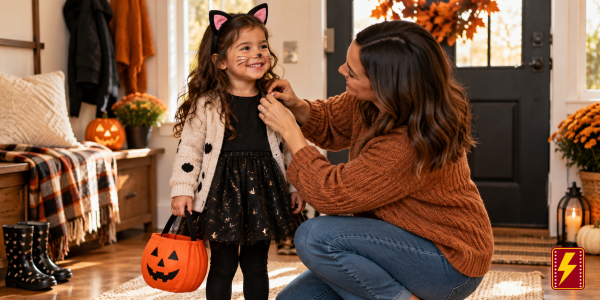
A cat look only needs three cues: lifted liner, a small nose shape and whiskers. Add soft contour around the temples or cheekbones if you want more structure. This is one of the best examples of a costume that becomes recognizable through makeup without needing a large accessory budget.
For children, simplify further. Comfort, visibility and wear time matter more than detail; our kids’ Halloween costume wear test covers how to check movement, warmth, bathroom access and visibility before the evening starts.
Novelty makeup should still be treated like cosmetics
Halloween packaging does not exempt a product from normal cosmetic safety. The FDA’s novelty makeup guidance advises following the label, using products only where they are intended to be used and keeping face paint away from the eyes when the label says it is not for that area.
The FDA also notes that Halloween and theatrical makeup are cosmetics and are subject to the same restrictions on approved color additives as other cosmetics. That is one reason not to substitute craft paint, markers, pigments or decorative products that were never made for skin.
If a novelty product smells unusually bad, looks separated in a way it should not, or has been sitting open in a costume box since last year, replacing it is safer than trying to rescue it.
Do not improvise around the eyes
The eye area is where “close enough” substitutions become a bad idea. FDA eye-cosmetic guidance recommends keeping applicators clean, washing hands before application, not sharing eye cosmetics and using products around the eyes only when they are intended for that area.
That means lip liner should not automatically become eyeliner, loose craft glitter should not become eye glitter, and old mascara should not be revived with water. If a product causes irritation, stop using it. Persistent irritation belongs with a healthcare professional, not another layer of makeup.
False lashes can add a lot to a Halloween look, but the adhesive also deserves attention. Read the ingredients and keep glue out of the eye itself. If you have never used that adhesive before, Halloween night is a poor time for the first trial.
Decorative contact lenses are not a costume-store impulse buy
Colored or theatrical contact lenses can completely change a character, which is exactly why they attract last-minute buyers. In the United States, however, decorative lenses are medical devices. The FDA says decorative contact lenses require a prescription and warns against buying them from novelty stores, beauty-supply stores, flea markets or other sellers that do not require one.
A poor fit or improper use can damage the eye. If a Halloween look depends on unusual eyes, make that decision early enough to involve an eye-care professional rather than treating lenses like costume jewelry.
Patch-test unfamiliar products before the event
A product can be marketed for the face and still disagree with your skin. The American Academy of Dermatology recommends testing a new skin-care product on a small area first and watching for redness, itching or swelling before using it more widely.
For a one-night Halloween product, the practical lesson is simple: do not open an unfamiliar adhesive, face paint or prosthetic product ten minutes before guests arrive. Test early enough that a reaction does not become part of the costume.
If your party plan is already packed with food, décor and other purchases, add the makeup rehearsal to the same preparation window you use for your Halloween party budget. A rehearsal often saves more than it costs because it exposes products you do not actually need.
Build the look in thin layers
Halloween makeup tends to fail when people try to make it dramatic in one pass. Thin layers are easier to control, easier to remove and less likely to crack or become uncomfortable.
Start with the broadest shapes, then add detail. For a skeleton, block in the eye sockets and cheek shadows before drawing teeth. For a vampire, finish the eye shape before deciding how much red the face needs. For a witch, get the liner balanced before adding glitter or lashes.
This also reduces waste. If the look already reads correctly at 70 percent intensity, there is no advantage in using twice as much product.
Match the makeup to the room, lighting and costume
Makeup that looks subtle in a bathroom mirror may disappear in a dark room, while a heavy look can become overpowering in daylight. Test the finished face in the lighting where it will actually be seen.
If you are hosting at home, coordinate the face with the atmosphere rather than competing with it. The Halloween decorating without the clutter guide is built around focal zones and lighting, which is useful here because better room lighting can make a simple makeup look feel more intentional.
For outdoor plans, remember that wind, cold and moisture affect comfort too. Our outdoor Halloween decorating guide focuses on weather, lighting, power and visitor flow; the same conditions are worth considering before choosing loose glitter, delicate lashes or anything that becomes annoying once you are outside for an hour.
Keep food, candy and makeup from competing for the same space
At a party, cosmetic tools should not live beside serving utensils. Give makeup its own small tray or bathroom area so brushes, lash glue and face paint do not migrate toward food.
If you are also handling trick-or-treaters, decide the candy setup before you start getting ready. Our calculator for how much Halloween candy you need helps estimate the crowd and reserve so you are not counting pieces with wet eyeliner and half-finished makeup.
Pets need separation too. Cosmetics, adhesives, small applicators and open doors can all become extra hazards in a busy house. The Halloween with pets guide covers doorbell stress, escape risk, costumes and candy so a pet does not have to be part of the makeup station or party traffic.
Removal is part of the look, not an afterthought
If a Halloween face takes forty minutes to apply, plan ten minutes for removal before you are exhausted. The American Academy of Dermatology recommends removing makeup before bed and cleansing gently rather than scrubbing aggressively.
Remove lashes slowly, dissolve long-wear products with an appropriate remover and wash away remaining makeup with a mild cleanser. Do not keep rubbing a stained area simply because some pigment remains. A second gentle cleanse is better than turning removal into abrasion.
Afterward, use the simple skin-care routine you already tolerate. Halloween night is not the time to combine heavy makeup removal with a brand-new exfoliating treatment.
Use a one-night budget for one-night products
Separate the makeup list into three columns:
| Use again | Maybe use again | Halloween only |
|---|---|---|
| Eyeliner | Colored shadow | Prosthetic appliance |
| Lipstick | False lashes | Specialty fake blood |
| Setting spray | Face gems | Character-specific paint color |
| Neutral shadow | Glitter | Single-use accessory |
Spend most carefully in the third column. A $12 product used once costs more per wear than a $22 eyeliner you use for months afterward.
If the costume retailer already has what you need, Spirit Halloween offers can be worth checking for the genuinely costume-specific pieces. The goal is not to avoid specialty products altogether; it is to reserve them for details that ordinary makeup cannot reproduce safely or convincingly.
Run the complete look before Halloween
A rehearsal should answer practical questions, not just “does it look good?” Wear the makeup with the costume, hairstyle, glasses or contacts you plan to use. Sit down. Smile. Eat something. Look down at your phone. Step into brighter and darker light.
Check:
- whether the eye makeup transfers;
- whether lashes lift at the corners;
- whether face paint cracks when you speak;
- whether the costume rubs makeup off the neck or jaw;
- whether glasses disturb the design;
- whether the full look still feels comfortable after an hour.
If you are getting ready close to the deadline, rehearsal also tells you what can be cut. A simpler version you can complete reliably is better than a complicated look that depends on perfect timing.
Final takeaway
Good Halloween makeup does not require a drawer full of products that only make sense in October. Start with the visual cue that makes the character recognizable, reuse ordinary cosmetics where they are suitable, and reserve specialty products for details that genuinely need them.
Keep novelty products within their intended use, be conservative around the eyes, treat decorative contacts as medical devices, test unfamiliar products before the event and plan removal before you start applying anything.
The strongest look is the one that still looks intentional after the party has been going for two hours—and that does not leave you wondering why you bought twelve products for one photograph.
Frequently Asked Questions
Can I use regular makeup for Halloween?
Yes. Many Halloween looks can be created with ordinary eyeliner, eye shadow, lipstick, foundation and powder. Specialty products are most useful when the look needs a color, texture or effect ordinary cosmetics cannot safely reproduce.
Can I use face paint around my eyes?
Only if the product is specifically intended for use in the eye area. Follow the label and keep products not approved for that area away from the eyes.
Do decorative Halloween contact lenses need a prescription?
In the United States, yes. Decorative contact lenses are regulated medical devices and should be fitted and purchased through appropriate prescription channels.
Should I test Halloween makeup before using it?
Testing unfamiliar products on a small area in advance can help reveal irritation or allergy before you apply the product across the face.
How can I make Halloween makeup last longer?
Apply thin layers, allow each layer to set, use compatible powder or setting products where appropriate, and test the finished look with the costume before the event.
What is the easiest Halloween makeup look?
A cat, vampire or graphic witch look can be simple because each depends on only a few recognizable cues rather than a full-face transformation.
What should I buy if I want to spend less?
Prioritize products you will use after Halloween, then buy only the one or two specialty items the character genuinely needs.