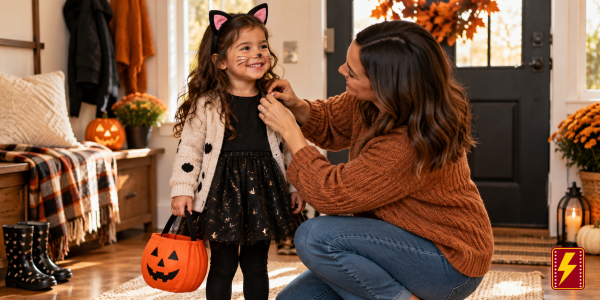


- Build Halloween décor around a few focal zones and visual hierarchy instead of filling every surface with seasonal objects.
- Use lighting, scale and a controlled color palette to create atmosphere before buying more props.
- Set a physical storage budget for Halloween decorations so new purchases must earn their space after the season ends.
- Favor reusable autumn-neutral pieces that can transition into November, then layer Halloween-specific details on top.
- Check seasonal lighting, cords and placement for safety, and let coupons improve a decorating plan rather than create one.
Halloween decorating gets expensive when every empty surface starts feeling like a place that needs one more ghost, pumpkin, sign, bat or candle.
The result is often a house with more Halloween objects but less atmosphere. A mantel is crowded. The entryway competes with the dining table. The porch has three different themes. Then November arrives and every piece needs somewhere to live for the next eleven months.
A better approach is to design the season around a few places people actually notice, then make those places feel intentional. You need fewer decorations when the lighting, scale and placement are doing more of the work.
This guide uses two limits to keep Halloween décor under control: visual hierarchy and a storage budget. The first tells you where to concentrate impact. The second stops seasonal decorating from quietly taking over closets, garages and spare rooms.
Decorate the route people experience, not every room you own
Think about how someone experiences your home.
For most households, that route is something like:
- front door or entry;
- living room;
- dining or kitchen area;
- possibly one party or photo area.
Those are the places that deserve most of the Halloween budget.
A guest does not need a themed laundry room, decorated hallway closet and Halloween bathroom shelf to understand the mood.
Choose three focal zones before you buy anything
A simple whole-home plan can work with just three zones:
- arrival zone: front door, entry table or hallway;
- main living zone: mantel, console, shelf or coffee table;
- gathering zone: dining table, kitchen island or party area.
Everything else can stay quieter.
This creates visual hierarchy: the eye knows where to look instead of seeing twenty small decorations competing for attention.
One large focal point usually beats ten small purchases
Current 2026 decorating guidance from major home retailers repeatedly uses the same design principle: choose one strong element, then layer smaller pieces around it.
That focal point might be:
- a large wreath;
- one substantial skeleton;
- a dramatic candelabra;
- a clustered pumpkin display;
- one oversized ghost;
- a statement light or projection.
The supporting pieces should help the focal point, not compete with it.
Use scale before quantity
A common reason seasonal décor looks cluttered is that everything is the same small size.
Instead, mix:
- one large piece;
- two or three medium pieces;
- a few small details.
This creates depth without requiring a large object count.
Choose a mood before choosing products
Halloween can mean very different things:
- classic orange and black;
- gothic and dramatic;
- cute ghosts and pumpkins;
- vintage carnival;
- witchy apothecary;
- harvest with subtle Halloween details;
- haunted-house theatrics.
Current 2026 trend coverage is especially broad, with vintage nostalgia, whimsical fantasy, gothic oxblood tones, ghostly fabrics and dramatic shadow lighting all appearing strongly.
You do not need all of them.
Pick one mood and let the whole home borrow from the same visual language.
Limit the palette to make inexpensive décor look more deliberate
A controlled color palette can make low-cost pieces feel more coordinated.
Examples:
- black + cream + brass;
- orange + black + natural wood;
- deep red + black + candlelight;
- white + gray + soft amber;
- purple + black + silver.
When every object shares part of the palette, the room looks designed rather than accumulated.
Use ordinary home décor as the base layer
You do not need every object to say “Halloween.”
Existing items can provide:
- black frames;
- wooden trays;
- neutral vases;
- dark cushions;
- candlesticks;
- baskets;
- mirrors;
- books.
Then seasonal pieces create the cue.
If you are replacing something permanent anyway, Furniture & Home Decor deals can be more useful than buying another novelty object that comes out once a year. Home Decor deals at DealsDasher can also help when the purchase needs to work beyond October.
Atmosphere can come from lighting before it comes from props
One of the clearest 2026 décor trends is the use of focused, shadowy lighting rather than bright overhead illumination.
Try:
- table lamps;
- amber bulbs;
- LED candles;
- spotlights;
- string lights;
- uplighting behind a plant or curtain;
- small battery lights inside pumpkins or jars.
Lighting changes the whole room while adding very little storage volume.
Turn off the ceiling light before buying more decorations
This is one of the cheapest Halloween decorating tests.
At night, turn off the main overhead light and use only lamps, candles or accent lighting.
Then look at the room again.
You may discover that the atmosphere already works and you need fewer physical decorations than expected.
Buy lighting for the room, not just Halloween
A lamp, dimmer-compatible fixture or useful accent light can continue serving the home after October.
If lighting is part of a permanent upgrade, 1StopLighting discount codes can be worth comparing, while lighting deals at DealsDasher give you a broader route for pieces that can work all year.
Temporary seasonal lighting needs a safety check
Anything moving outside needs a separate weather-and-power plan; our outdoor Halloween decorations guide covers anchoring, visitor flow and exterior lighting in more detail.
CPSC guidance identifies seasonal lighting as a product category where inadequate wiring, strain relief or overcurrent protection can create shock or fire hazards.
Before using decorative lights:
- inspect for damaged wires;
- check cracked sockets;
- use products designed for the intended location;
- follow load guidance;
- avoid damaged extension cords;
- keep connections away from moisture.
For outdoor use, use products clearly intended for outdoor conditions.
Do not run one extension cord as the backbone of an entire display
A Halloween scene can accumulate:
- lights;
- projectors;
- inflatables;
- animatronics;
- speakers.
Plan power before adding more electrical pieces.
The entry should communicate the whole theme in ten seconds
Your entry does not need to contain everything.
It needs one clear message.
A simple combination could be:
- wreath;
- two pumpkins;
- one light source;
- one small detail such as bats or a sign.
That is enough to establish the mood.
Use vertical space instead of covering every surface
Wall bats, hanging ghosts, garlands and fabric draping can create impact without using table, shelf or floor space.
This is especially useful in smaller homes.
Keep pathways visually and physically clear
Seasonal décor should not make normal movement awkward.
Do not let:
- fabric trail across walkways;
- pumpkins narrow stairs;
- cords cross traffic paths;
- props block doors;
- candles sit where clothing can brush them.
The living room only needs one dominant Halloween moment
If that focal point is also where people will take costume photos, coordinate it with your Halloween makeup plan rather than buying extra props just for the camera.
Choose the strongest surface:
- mantel;
- media console;
- bookshelf;
- coffee table;
- sideboard.
Then let other surfaces echo it lightly rather than building separate themes everywhere.
Use odd-number groupings for small objects
Three pumpkins usually read more intentionally than eight scattered ones.
Try groups of:
- three;
- five;
- seven for larger displays.
Vary height and size.
Trays and risers create order
A tray can turn several small Halloween objects into one visual unit.
Use:
- books;
- boxes;
- cake stands;
- wooden risers;
- trays.
to create height without buying more décor.
A Halloween table should still function as a table
Do not build a centerpiece that must be removed every time someone eats.
Keep:
- plate space;
- serving space;
- clear sightlines;
- safe candle placement.
If the table is for a party, Factory Direct Party coupons can be useful for planned tableware or serving pieces, but avoid filling the basket with disposable décor that has no role in the event.
Food presentation can do part of the decorating
If the table is also serving trick-or-treaters, calculate how much Halloween candy you need before using candy itself as decorative volume.
At a Halloween party, the table can look seasonal through:
- dark serving bowls;
- orange drinks;
- candies;
- pumpkin-colored foods;
- themed cake or cookies.
This reduces the need for more decorative objects.
Use real pumpkins strategically
Pumpkins provide:
- color;
- scale;
- height variation;
- natural texture.
They also do not need to be stored for eleven months.
Carve pumpkins later than you place whole pumpkins
Whole pumpkins can be displayed earlier, while carved jack-o’-lanterns have a shorter useful life.
Current fall decorating advice recommends treating carving as a later-season layer rather than the beginning of the display.
Mix Halloween-specific and autumn-neutral pieces
This creates a longer decorating season.
Examples:
- pumpkins;
- branches;
- candlesticks;
- dark linens;
- neutral wreaths;
- wooden trays;
- autumn florals.
Then remove:
- bats;
- skulls;
- ghosts;
- webs;
after Halloween and keep the autumn layer through Thanksgiving.
The transition-to-November test can prevent waste
Before buying a décor item, ask:
Can this remain useful after October 31 if I remove the Halloween-specific layer?
If yes, it has a longer seasonal life.
Set a storage budget before setting a shopping budget
This is the key rule.
Decide how much space you are willing to give Halloween décor when it is not in use.
For example:
- one large storage bin;
- two medium bins;
- one shelf in the garage;
- one under-bed box.
Once the space is full, new items must replace old ones rather than simply adding another container.
A storage budget makes large props much easier to evaluate
Before buying a large skeleton, inflatable or animatronic, check:
- assembled size;
- packed size;
- whether it breaks down;
- whether the original box must be kept;
- whether moisture will damage it;
- where it will live from November to September.
Flat, foldable and stackable décor has a hidden advantage
Examples include:
- fabric banners;
- paper decorations;
- flat signs;
- collapsible props;
- nesting pumpkins;
- folding silhouettes.
They create more visual impact per cubic foot of storage.
Storage containers are part of seasonal décor cost
If Halloween now requires:
- three new bins;
- shelving;
- garage organizers;
- protective cases;
that storage cost belongs to the decorating budget.
Storage & Organization deals at DealsDasher can be useful when organization itself is a permanent home need, not merely a way to justify buying more seasonal décor.
Label décor by zone, not by product type
Instead of:
- pumpkins;
- lights;
- ghosts;
try:
- entry;
- living room;
- party table.
Next year, you can decorate one zone at a time without opening every box.
Take a photo before packing everything away
A quick photo shows:
- what worked;
- where cords were routed;
- which pieces were grouped;
- what looked too crowded.
That makes next year faster and helps prevent buying duplicates.
Keep a “do not buy next year” note
At the end of the season, note:
- what you did not use;
- what broke;
- what felt like clutter;
- what you wished you had.
This is much more useful than trying to remember eleven months later.
Buy replacement pieces, not emotional duplicates
Seasonal shopping encourages duplicates:
- another pumpkin;
- another ghost;
- another sign;
- another black candleholder.
Before buying, ask what the new item replaces or improves.
One-in, one-out keeps seasonal collections useful
If the storage budget is full, a new item means:
- sell one;
- donate one;
- discard one that is damaged.
Trends should influence styling, not force replacement
Current 2026 Halloween decorating trends include:
- vintage nostalgia;
- whimsical fantasy;
- gothic red and black;
- ghostly draping;
- dramatic spotlighting.
You can often adapt existing décor to a trend by changing:
- lighting;
- fabric;
- color;
- arrangement.
You do not need to replace the collection.
Use fabric to change scale cheaply
That same fabric-first thinking can carry into a DIY Halloween costume built from clothes you already own instead of creating a separate craft-shopping list.
Cheesecloth, dark fabric, old sheets and draping can create:
- ghosts;
- curtains;
- table texture;
- backdrops;
- haunted portraits.
Fabric folds down much smaller than hard plastic props.
DIY should reduce cost or storage—not create a second craft inventory
A DIY project is worthwhile when:
- you already own the materials;
- the result is reusable;
- the project itself is enjoyable.
It is less economical when you buy:
- special tools;
- large amounts of craft material;
- paint used once;
- storage for the finished project.
Party décor should be purchased against the guest experience
If the décor is for a hosted event, set the spending ceiling with our Halloween party budget guide before adding more themed pieces.
For a party, prioritize places guests interact with:
- entry;
- food table;
- drinks;
- photo area;
- bathroom path;
- outdoor entrance.
Decorating unused bedrooms adds little to the event.
Event-specific pieces can be rented, borrowed or shared
If the event also involves buying costumes, use our where to buy Halloween costumes guide to separate fit and return risk from décor spending.
For one-night props, compare:
- purchase;
- rental;
- borrowing;
- sharing with friends or neighbors.
A dramatic piece can be memorable without becoming permanent storage.
Do not buy fragile décor if children or pets will interact with the space
For children, keep costume movement and visibility in mind too; our kids’ Halloween costume guide covers the wear-test side of the night.
If pets share the space, use our Halloween with pets guide to plan costumes, doorbell traffic and quiet areas around the décor.
Think about:
- glass;
- open flame;
- small detachable parts;
- low hanging cords;
- unstable stands.
Use the household you actually have, not the styled photo.
LED candles often outperform open flame for Halloween atmosphere
They can provide:
- flicker;
- low light;
- placement near fabric;
- longer unattended use.
They also pack away easily.
A decorating budget works better by zone than by item
Instead of setting a total and shopping randomly, divide it:
- 40% entry or exterior;
- 30% main living area;
- 20% party/table area;
- 10% replacement lights, batteries or storage.
The percentages can change. The point is to prevent one attractive aisle from consuming the entire budget.
Coupons should improve a plan that already exists
If you are already close to October 31, switch from browsing to essentials with our last-minute Halloween shopping guide.
First decide:
- theme;
- focal zones;
- storage limit;
- missing pieces.
Then compare discounts.
If a promotion excludes seasonal or clearance décor, our guide to common coupon restrictions can help explain why.
Free shipping should not become an excuse for another decoration
If the basket is below a free-delivery threshold, compare the delivery fee with the cost of the extra item you are considering.
Our guide to free shipping versus percentage discounts can help when the “free” shipping requires spending more than you planned.
The Halloween décor audit before checkout
Before buying another piece, answer:
- Which focal zone is this for?
- What existing piece does it replace or improve?
- Does it match the chosen mood and palette?
- Could lighting create the same impact?
- Can it be reused after Halloween or next year?
- How much storage space does it require?
- Does it need electricity, batteries or extension cords?
- Is it safe for the intended location?
- Will the room still function normally?
- Would I buy it if it were not presented as seasonal décor?
The “buy now” décor test
Buy when:
- the item fills a defined gap;
- it strengthens a focal zone;
- it fits the storage budget;
- the price is good;
- you expect repeated use.
The “wait” décor test
Wait when:
- you have not unpacked last year’s décor yet;
- the new item duplicates something you own;
- you have not measured the space;
- the product requires more storage than expected;
- you are buying because the trend is new rather than because it fits your home.
The “walk away” décor test
Walk away when:
- you cannot name where it will go;
- it creates another storage bin;
- it makes an already busy room busier;
- it requires unsafe power routing;
- the low price is the only reason you want it.
Final takeaway
A finished Halloween home does not need Halloween objects on every surface.
Choose a mood. Pick three focal zones. Use scale and lighting to create atmosphere. Keep ordinary home décor as the base layer. Buy pieces that can transition into autumn or survive several seasons. And set a physical storage limit before you set a shopping budget.
When the decorations come down, you should be able to pack Halloween away without wondering how the collection doubled again.
The strongest Halloween decorating plan is the one that looks deliberate in October and still feels manageable in November.
Frequently Asked Questions
How do I decorate for Halloween without making my home look cluttered?
Choose a clear mood, limit decorating to a few focal zones, use one larger statement piece in each area and rely on lighting rather than filling every surface with small objects.
What are the main Halloween decorating trends for 2026?
Current 2026 coverage includes vintage nostalgia, whimsical fantasy, gothic red-and-black palettes, ghostly draping and dramatic shadow-focused lighting.
When should I start decorating for Halloween?
September works well for autumn-neutral pieces, while more explicitly Halloween items can be layered in during late September or October. Carved pumpkins are best added closer to Halloween because they deteriorate faster.
How many Halloween decorations do I need?
There is no ideal number. A few coordinated focal points usually create more impact than many unrelated small pieces.
How can I make Halloween décor reusable?
Use neutral pumpkins, candles, trays, fabrics and lighting as the base, then add removable Halloween-specific pieces such as bats, skulls or ghosts.
How should I store Halloween decorations?
Set a fixed storage limit, pack by decorating zone, protect fragile pieces and take photos of successful setups so you can recreate them easily next year.
Are Halloween lights safe to use outdoors?
Use products clearly rated for outdoor use, inspect wiring and sockets, use appropriate extension cords and avoid damaged electrical products or unsafe cord routing.
What is the biggest Halloween decorating mistake?
Buying objects without deciding where they will go, which usually creates visual clutter in October and unnecessary storage problems for the rest of the year.