

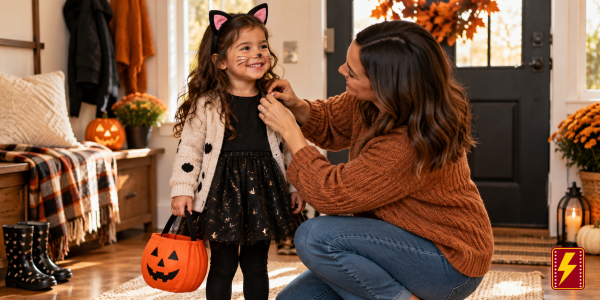
- Use a 2-hour wear test before Halloween: check walking, stairs, visibility, warmth, bathroom access and whether the child still wants the costume on.
- Measure over the layers the child may need outdoors, but do not size up so far that hems, sleeves or capes become trip hazards.
- Prioritize sturdy shoes, clear vision and reflective details over perfect character accuracy for trick-or-treating.
- Keep masks, hats, capes and props removable so uncomfortable pieces can come off without destroying the whole costume.
- Judge the real costume price by fit, reusable layers, safe footwear and visibility—not only the packaged costume price.
A kids’ Halloween costume succeeds when the child still wants to wear it after the first photo.
That sounds obvious, but costume shopping often starts with the character image rather than the evening the child is actually going to have. A costume can look perfect on a product page and fail once a child needs to walk several blocks, climb porch steps, wear a warm layer underneath, carry a treat bag, use the bathroom, see clearly after dark and stay comfortable for more than a few minutes.
The easiest way to avoid that is to stop treating fit as a thirty-second mirror check. Use a two-hour wear test instead. You do not literally need to make a child wear the costume for two hours before Halloween, but you should judge every part of it against the demands of a two-hour outing.
The two-hour wear test starts before you buy
Before choosing a costume, picture the actual Halloween plan. Will the child be indoors at a school event? Walking outdoors after dark? Riding in a car between neighborhoods? Attending a party before trick-or-treating? Wearing the costume over warm clothes?
Those details matter more than the product photo.
A practical kids’ costume should pass six questions:
- Can the child walk and climb stairs normally?
- Can they see and hear clearly?
- Can the costume handle the expected temperature?
- Can they use the bathroom without a full costume reset?
- Can the child carry a treat bag without losing pieces of the costume?
- Would they still be comfortable after an hour or two?
If the answer to several of those is no, changing the costume now is easier than negotiating with an uncomfortable child halfway through the evening.
Fit comes before character accuracy
The American Academy of Pediatrics’ Halloween safety guidance for families recommends checking that costumes and shoes fit well and that costumes are short enough to reduce tripping and snagging. That is a useful reminder because “technically the right size” is not the same as “comfortable for real walking.”
Check the retailer’s measurements instead of buying from age labels alone. Children of the same age can have very different heights and proportions, and costume sizing can vary between manufacturers.
For regular clothing pieces that may become part of the costume, Kids Clothing deals can be useful when you need leggings, a base layer, a sweater or ordinary shoes that can still be worn after Halloween. The broader Baby, Kids & Family deals section can help when the shopping list includes more than the costume itself.
Run the movement test in the shoes the child will actually wear
A costume does not pass the wear test while the child is standing still in socks. Put on the shoes that will be worn on Halloween and ask the child to:
- walk across the room;
- go up and down a few stairs;
- sit on the floor and stand up;
- bend to pick something up;
- raise both arms;
- turn quickly;
- carry an empty treat bag.
Watch what happens to capes, hems, tails, wings and oversized accessories. If the child keeps stepping on something, catching a sleeve or removing a prop because it is annoying, the costume is telling you what needs to change.
The best fix is often subtraction. Shorten the cape, remove the rigid prop, swap the oversized shoe cover for ordinary footwear, or keep the wings for the party and leave them home for the outdoor walk.
Visibility should be built into the costume, not added as a panic fix
The U.S. Consumer Product Safety Commission recommends bright costumes or reflective details so children are easier to see after dark. CPSC also recommends reflective tape on costumes and treat bags.
That does not mean every costume needs to look like safety equipment. Reflective material can often be placed:
- along the edge of a cape;
- on a treat bag;
- around a belt;
- on shoes;
- on the back of a jacket or outer layer;
- on a wrist or ankle where movement makes it noticeable.
If the character is supposed to wear dark clothing, the visibility solution should work with the costume rather than fighting it.
Outdoor setup matters too. If you are decorating your own home, the outdoor Halloween decorations guide covers walkway lighting, power, anchoring and visitor flow so costumes are moving through a yard designed for people, not just photos.
Masks should not win an argument with eyesight
The AAP suggests non-toxic makeup or decorative hats as alternatives to masks when a mask could interfere with vision. If a child insists on wearing one, test it under realistic conditions.
Have the child look:
- straight ahead;
- down at their feet;
- left and right without turning the whole body;
- up a set of stairs;
- toward something approaching from the side.
If the eye openings force the child to move the mask constantly, widen the openings if the product can be modified safely or use the mask for photos and remove it for walking.
Makeup can solve the same character problem without blocking peripheral vision. Our Halloween makeup at home guide focuses on simple looks using products with a life after October. For children, keep the design simpler, use products intended for the area where they are applied, and test unfamiliar products before Halloween night.
Decorative contact lenses are not a shortcut for a kids’ costume
The AAP also warns against decorative contact lenses without an eye exam and prescription. That is important because costume packaging can make theatrical lenses look like an ordinary accessory even though they are medical devices.
For children, there is rarely any need to make a costume depend on colored lenses. Makeup, glasses frames without lenses, a hat or one recognizable clothing cue can usually carry the idea without adding an eye-care issue to Halloween night.
Warmth should be planned under the costume
Cold-weather planning works best when it starts before the costume is fitted. AAP cold-weather guidance recommends several thin layers for children outdoors in cold conditions, along with warm footwear, gloves or mittens and a hat. The National Weather Service similarly recommends dressing in layers and keeping exposed skin covered in extreme cold.
The practical costume lesson is to build room for layers rather than trying to force a winter coat over a tightly fitted costume five minutes before leaving.
Useful base layers include:
- long-sleeve tops close to the costume color;
- leggings or thermal bottoms;
- thin fleece where the costume allows it;
- warm socks;
- ordinary shoes or boots that still fit the character.
Try the costume over those layers before Halloween. A costume that fit perfectly over a T-shirt may become restrictive when two warm layers are added underneath.
Do not let a coat “ruin” the costume
If the weather requires outerwear, the child should wear outerwear. The costume can be designed around that reality.
A black coat can become part of a vampire, witch, spy or wizard look. A brown jacket can support an explorer, detective or western theme. A hoodie can fit a skeleton, animal or character costume when the face and accessories carry the concept.
This is where the closet-first method in our DIY Halloween costume guide is particularly useful. It is often easier to build the costume around clothing that already handles the weather than to buy a thin packaged costume and then hide it under a coat.
Bathroom access is part of costume fit
This is easy to overlook because product photos rarely show how the costume opens. Before Halloween, ask the child to use the bathroom while wearing the complete outfit.
Watch for:
- one-piece costumes with difficult back zippers;
- belts that must be completely removed;
- wings attached over closures;
- long skirts that drag on the floor;
- gloves that make buttons or zippers difficult;
- layers that require adult help every time.
If the child cannot manage the costume independently enough for their age and setting, simplify the closure or separate the outfit into easier layers.
For younger children, convenience usually matters more than costume accuracy. A slightly simpler version that survives the whole evening is better value than an elaborate version that spends half the night in a parent’s bag.
Props should be flexible, lightweight and optional
CPSC guidance recommends soft, flexible costume accessories instead of rigid or sharp swords, knives and similar props. That makes sense even when the prop is technically a toy.
Ask whether the child can:
- carry the prop and a treat bag at the same time;
- walk up stairs without hitting the prop against railings;
- sit in a car while holding it;
- put it down without losing the rest of the costume.
If not, take the prop for photos and leave it home for trick-or-treating.
Children often stop carrying elaborate props long before the costume itself becomes uncomfortable. Do not make the costume depend on something the child is unlikely to carry for two hours.
Flame resistance still matters in a battery-light world
Open candles are less common in many Halloween displays than they once were, but they still exist, and costumes may also pass near fire pits, cooking areas or other heat sources. CPSC recommends looking for flame-resistant costume materials and avoiding flimsy, billowing designs that can make contact with flame more easily.
Check labels on:
- costumes;
- wigs;
- beards;
- capes;
- fabric accessories.
“Flame resistant” does not mean something cannot burn. It means the material has characteristics intended to resist ignition or slow burning. Keep children away from open flames regardless of the label.
If you are hosting at home, the Halloween decorating without the clutter approach favors lighting and a few strong focal areas over filling every surface with decorations, which also makes it easier to keep walking space clear.
Choose the retailer based on the risk you need to reduce
For kids’ costumes, the “best” store is not the same for every family. If fit is uncertain, returns and local try-on options matter. If the child wants a licensed character, selection matters. If Halloween is close, confirmed stock and pickup matter more than browsing hundreds of unavailable options.
Our guide to where to buy Halloween costumes compares those trade-offs in more detail.
For current costume inventory, HalloweenCostumes.com deals and Spirit Halloween offers can be useful when you need a dedicated costume retailer. Cazaar Fancy Dress deals provide another costume-focused option, while Hanna Andersson offers may be more relevant when the Halloween look overlaps with comfortable children’s clothing that can be worn again.
The 48-hour rule: stop trying to perfect the original idea
When Halloween is two days away, reliability becomes more important than finding the exact version imagined three weeks earlier.
Switch to:
- local stock;
- clothing already in the house;
- simple makeup;
- one recognizable accessory;
- ordinary shoes;
- a character that can absorb a warm jacket or layer.
The last-minute Halloween shopping guide is built around that substitution-first approach. It is especially useful with children because an “almost perfect” costume that arrives on time and feels good usually beats the exact costume that never becomes wearable.
Budget for the complete night, not only the costume
Costume price is only one part of Halloween spending. Shoes, makeup, accessories, candy, decorations and a party can turn several individually reasonable purchases into a surprisingly expensive month.
Keep the child’s costume in its own budget. If you are hosting, use the Halloween party budget guide to separate food, atmosphere and activities from costume spending.
If you are also handing out treats, calculate that separately with our Halloween candy calculator. A costume has not become cheaper just because candy and décor are being ignored in another part of the basket.
Pets and children need separate Halloween plans
A child may be excited about matching the family pet, but the pet does not automatically share that enthusiasm. Costumes, repeated doorbells, children moving in and out and open front doors can create a very different evening for an animal.
Our Halloween with pets guide starts with stress, candy, escape risk and quiet space before costume ideas. Treat the child’s costume and the pet’s comfort as separate decisions rather than forcing both into one visual theme.
The final two-hour wear-test checklist
On the day before Halloween, dress the child in the full costume with the actual shoes and any warm layers you expect to use. You do not need a literal two-hour rehearsal. Run a concentrated twenty-minute test that simulates the important parts of the evening.
Check:
- Walk: Can the child move at a normal pace without lifting the costume?
- Stairs: Can they see their feet and climb safely?
- Sit: Does the costume bunch, pull or become uncomfortable?
- Turn: Does a mask, hat or hood interfere with side vision?
- Reach: Can the child open a door, hold a railing and carry a bag?
- Bathroom: Can the costume be managed quickly enough?
- Warmth: Do needed layers still fit comfortably underneath?
- Visibility: Is there a reflective or bright element for darkness?
- Prop: Is every accessory safe, flexible and actually worth carrying?
- Comfort: Is the child already trying to remove something?
Any item that repeatedly fails the test should be changed before Halloween, not defended because it “looks good.”
Final takeaway
The best kids’ Halloween costume is not the one that looks most accurate in the first photograph. It is the one that survives the evening.
Choose fit before detail. Make visibility part of the design. Build warmth underneath. Keep masks from blocking vision, props lightweight and costume pieces short enough to walk in. Test bathroom access and real shoes. Use reflective details after dark, and do not make the costume depend on a novelty accessory the child cannot comfortably wear or carry.
If a costume passes the two-hour wear test, the child has a much better chance of enjoying Halloween instead of spending it adjusting, removing or carrying pieces that looked better online than they felt in real life.
Frequently Asked Questions
How should a kids’ Halloween costume fit?
It should allow normal walking, sitting, arm movement and stair climbing without dragging, tightening or blocking vision. Use the retailer’s current measurements rather than age labels alone.
Are masks safe for trick-or-treating?
A mask should not restrict vision or breathing. If the child cannot see clearly to the sides or down toward steps, a simpler face-paint or hat-based option may work better.
How can I keep a child warm without ruining the costume?
Plan thin warm layers underneath the costume and test the full outfit before Halloween. When necessary, make a coat or jacket part of the character rather than leaving the child underdressed.
Should children wear decorative contact lenses for Halloween?
Decorative contact lenses are medical devices and should not be used without appropriate eye care, fitting and prescription requirements.
What kind of Halloween costume prop is best for a child?
Choose something lightweight, soft or flexible that does not interfere with walking, stairs or carrying a treat bag.
How can I make a dark costume more visible?
Add reflective material to the costume, shoes or treat bag and use a flashlight or other suitable light so the child is easier to see after dark.
What is the biggest mistake when buying a kids’ Halloween costume?
Choosing mainly by character or appearance without testing fit, warmth, visibility, shoes, bathroom access and the child’s comfort over a longer outing.