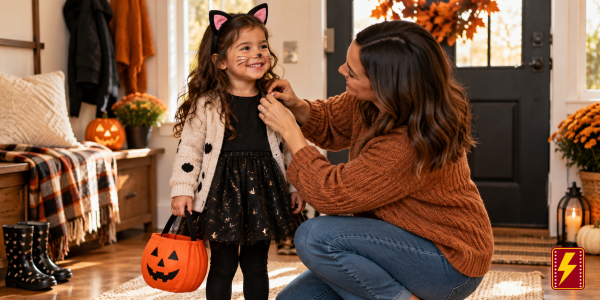


- Triage last-minute Halloween purchases into must-have, easy substitute and skip so time goes toward the things that can actually derail the night.
- Prioritize confirmed local stock or reliable delivery over a slightly larger discount when Halloween is only days away.
- Build costumes from clothing you already own, then add one recognizable cue instead of searching indefinitely for a sold-out packaged costume.
- Simplify party food and décor: one filling menu, one focal decorating area and safe lighting usually outperform rushed themed purchases.
- Set hard time and delivery cutoffs so last-minute bargain hunting does not consume the day or create orders that arrive after Halloween.
Last-minute Halloween shopping is not a smaller version of early Halloween shopping. The priorities change.
When Halloween is still weeks away, selection and price can lead the decision. When it is three days away, certainty matters more: whether the costume fits, whether the candy is actually in stock, whether the decoration works, whether makeup can be used safely, and whether the order can realistically reach you before the event.
The easiest way to make good decisions under that pressure is to stop treating every item as equally important. Buy what protects the evening, substitute what can change without hurting the plan, and skip anything that has become more trouble than it is worth.
Use a 72-hour decision rule
At roughly three days out, divide the shopping list into three groups:
| Buy | Substitute | Skip |
|---|---|---|
| Items the evening cannot run without | Things where color, brand or style can change | Extras that do not affect comfort, food, safety or the main visual idea |
| Costume base or shoes | One prop for another | Second or third decorative detail |
| Candy or party food | Different candy assortment | Novelty serving pieces |
| Required lighting or batteries | Different decoration style | Extra décor for an already-finished area |
This prevents the classic last-minute mistake: spending forty minutes searching for a minor item while a major need is still unresolved.
At 72 hours: protect the costume, food and lighting first
Three days out, there is still enough time to compare a few options, but not enough time to rely casually on uncertain delivery.
Prioritize:
- the main costume or clothing base;
- shoes the wearer can actually walk in;
- candy and essential party food;
- required makeup products;
- batteries, outdoor-rated cords or lighting needed for a display;
- anything that must fit a child or pet safely.
If one of those is unresolved, stop shopping for decorative extras until it is handled.
Delivery dates are promises you should verify, not vibes
The U.S. Federal Trade Commission’s prompt-delivery guidance for internet sellers explains that sellers should have a reasonable basis for the shipping time they advertise and must address delays under the applicable rules.
For you as the shopper, the practical lesson is simpler: read the actual delivery estimate attached to the item and destination. Do not assume a familiar retailer, expedited badge or marketplace listing guarantees arrival before Halloween.
If the event is now close enough that one delayed shipment ruins the plan, switch to local pickup, confirmed store stock or a substitute you can physically secure.
At 48 hours: certainty beats the perfect item
Two days before Halloween, the original vision should lose priority to availability.
If the exact costume is sold out, ask what makes the idea recognizable. Is it the silhouette? One hat? A color? Makeup? A jacket? A prop?
The DIY Halloween costumes guide uses that exact principle: build around one recognizable cue and ordinary clothing rather than trying to reproduce every detail.
If a complete costume is still the better option, our guide to where to buy Halloween costumes compares dedicated costume retailers around fit, returns, specialist selection and last-minute reliability.
At this stage, Spirit Halloween offers and HalloweenCostumes.com deals can be useful when the item is genuinely available in a format that can reach you in time. Availability should decide whether you keep browsing.
At 24 hours: switch from “shopping” to “problem solving”
The day before Halloween, every purchase should solve a specific problem.
Good last-day purchases include:
- plain black clothing to finish a costume;
- eyeliner or lipstick for one recognizable makeup cue;
- batteries for working decorations;
- candy to cover an estimated crowd;
- reflective tape or a flashlight for visibility;
- one replacement prop when the original broke;
- food or drinks for confirmed guests.
Weak last-day purchases include:
- another decoration for an already-full room;
- a costume accessory that only makes sense with an item you still do not own;
- a giant mixed candy bag because it is discounted;
- specialty makeup you have never tested;
- a large outdoor prop you have no time to anchor or wire correctly.
Halloween morning: the shopping list should get shorter, not longer
On Halloween itself, use a hard stop rule.
Only buy something if it does one of four things:
- makes the costume wearable;
- makes the event usable or safer;
- feeds expected guests or trick-or-treaters;
- replaces something essential that failed.
If it does not fit one of those categories, it can probably wait until next year.
Costumes: buy the base, substitute the detail
When costume shopping is late, protect the silhouette and comfort first.
For adults, that often means ordinary clothing from Fashion & Apparel deals plus one character cue.
For children, do not let the deadline erase fit and visibility checks. The two-hour kids’ costume wear test covers shoes, warmth, masks, bathroom access and movement. A costume that technically arrived on time but cannot be worn comfortably is still a failed purchase.
The CPSC’s Halloween safety guidance also recommends well-fitting costumes, clear visibility and reflective details for children after dark. Last-minute should not mean skipping those checks.
Makeup: use what you already know how to use
Halloween morning is a poor time to learn a complicated special-effects technique or test several unfamiliar products.
Use normal eyeliner, shadow, lipstick and base products where they can create the effect safely. The Halloween makeup at home guide shows how to build recognizable looks from reusable products.
If one ordinary product is missing, Ulta Beauty deals may be useful for a practical beauty purchase, while Beauty & Personal Care deals can help compare options that remain useful after Halloween.
Do not replace cosmetic products with craft paint, markers or other materials not intended for the face just because time is short.
Candy: calculate before buying whatever is left on the shelf
Late candy shopping becomes expensive when quantity is based on package size instead of expected visitors.
Use the formula in How Much Halloween Candy Do You Need?: expected visitors × pieces per visitor × a modest reserve.
Then buy the closest practical package combination.
If your normal grocery shop can supply it, Morrisons Grocery deals may be more useful than making a separate candy trip. The broader Food, Grocery & Delivery deals section can help when candy is part of a larger planned basket.
Do not let low stock push you into bad allergy decisions
Late shopping does not make labels less important.
The FDA’s food-allergen guidance explains that packaged foods should identify major allergens as required by U.S. labeling rules. Keep candy in its original packaging so families can check ingredients.
If the usual assortment is gone, switch brands or formats rather than handing out unwrapped or unlabeled food because it was the only thing available.
Party food: protect the menu structure, not every original recipe
A last-minute party does not need the exact menu you planned two weeks ago.
Protect three things:
- something substantial enough for the event;
- easy snacks or finger food;
- drinks.
Then simplify the themed extras.
The Halloween party budget guide focuses spending on what guests actually notice. At the last minute, convenience may legitimately be worth more than a small price saving if it prevents several extra stops.
Indoor décor: finish one focal area and stop
If your living room already looks seasonal, another cart of small decorations will not rescue Halloween.
The Halloween decorating without the clutter guide uses focal zones instead of decorating every surface. That approach becomes even more valuable at the deadline.
Choose one unfinished area—entry table, mantel, dining surface or photo corner—and finish that.
If one craft element is missing, Michaels Stores offers can be useful for a targeted supply run. Do not reopen the entire decoration plan while you are there.
Outdoor décor: buy function before spectacle
One day before Halloween, a large inflatable or animatronic is usually a worse purchase than lighting, batteries, stakes or an outdoor-rated cord that makes the existing display work.
The outdoor Halloween decorations guide covers visitor flow, weather, anchoring, power and storage in detail.
For practical outdoor items, Lowe’s deals may be useful when the missing need is hardware, path lighting, cord management or another functional item. Home & Garden deals can help compare products that remain useful beyond October.
Check the weather before buying anything that only works outdoors
If wind or rain is likely, do not spend the last shopping window buying fabric, paper or lightweight yard décor you may immediately need to remove.
The National Weather Service advises securing or bringing in loose outdoor objects before high-wind events. Its high-wind preparedness guidance is a useful reminder that weather can change the outdoor plan faster than a missing prop can.
Shift the budget indoors if the forecast makes the yard setup impractical.
Pets: last-minute shopping should reduce stress, not add a costume
If a dog or cat is already likely to struggle with doorbells, crowds or open doors, buying a costume on Halloween day does not solve the problem.
The Halloween with pets guide prioritizes a quiet room, door control, candy safety and identification before costumes.
A replacement ID tag, secure gate, reflective lead or familiar enrichment item is a more useful last-minute pet purchase than a novelty outfit the animal has never worn.
Use pickup strategically
Pickup is valuable when it removes delivery uncertainty, but only if the specific item is actually ready.
Do not confuse “available at this store” with “reserved for you.” Complete the retailer’s pickup process, wait for confirmation where required and check any pickup deadline.
If an item is low stock and critical, have a backup in the same area before leaving home. A five-minute substitution is better than crossing town twice because the original disappeared.
Build your shopping route before you leave
Last-minute Halloween shopping becomes inefficient when the car route follows the order in which you remembered things.
Group needs:
- grocery/candy;
- costume/clothing;
- beauty;
- home/craft;
- pet or child-specific needs.
Then choose the smallest number of stops that can solve the largest number of problems.
A store that is slightly more expensive but covers candy, batteries and one costume basic may be the better last-minute choice than three cheaper stores requiring separate trips.
Do not chase a coupon harder than the purchase deserves
Deals still matter, but time is now part of the cost.
Use a promo code when it is easy, relevant and does not create a new threshold problem. Do not spend twenty minutes trying codes to save $3 on an item you need immediately.
Minimum-spend offers are especially dangerous late in the process. If you need $18 of supplies, spending $35 to unlock a discount is not saving.
Compare the final basket and move on.
Use a substitute ladder instead of restarting the search
When the exact item is unavailable, move down this ladder:
- Exact equivalent: same function, different brand or color.
- Functional substitute: different item that solves the same problem.
- DIY version: use what is already at home plus one small purchase.
- Remove the dependency: change the costume, menu or display so the item is no longer required.
- Skip it: if the plan still works without it.
This keeps one sold-out item from forcing a full redesign.
Know what not to substitute
Some categories should not be improvised just because the clock is running:
- safe footwear for a child;
- proper outdoor-rated electrical products;
- cosmetics intended for the body area where they will be used;
- clearly labeled food for allergy-sensitive situations;
- secure pet restraint or identification;
- weather-appropriate clothing.
Substitute style, brand and color before substituting basic safety or suitability.
Use a 30-minute final audit before the last store run
Before leaving for the final time, walk through the actual Halloween plan.
Check:
- Costume: Is every person able to get dressed completely?
- Shoes: Can they walk comfortably?
- Makeup: Are the necessary products already available?
- Candy: Is the quantity enough for the estimated crowd?
- Party: Are food, drinks and serving basics covered?
- Indoor décor: Is at least one focal area finished?
- Outdoor décor: Does the display have working power, lighting and anchors?
- Pets: Is there a quiet-space and door-control plan?
- Weather: Does anything need to change because of the forecast?
Only put items on the final shopping list when they solve a failed check.
Stop shopping once the night is staged
The last useful step is not another store run. It is putting every essential item where it will be used.
Lay out each costume with shoes, warm layers and accessories. Put makeup and removers together. Move candy into its handout area but keep reserve bags sealed. Place batteries beside the decoration they belong to. Set party food, serving pieces and drinks in one zone. Put pet supplies in the quiet-room setup rather than leaving them mixed with party gear.
Then do one failure check: if a single item disappeared right now, would Halloween still work? If the answer is yes, stop browsing. If the answer is no, solve only that dependency.
This is especially useful with costumes. If the character still depends on one fragile prop, create a version that reads without it. If the outdoor display depends on one powered item, make sure the yard still has enough practical lighting if that item fails. If the candy plan depends on one unopened box, keep it accessible rather than buried under party supplies.
Once the essentials are staged, treat new ideas as next-year ideas. Last-minute browsing has a way of creating new problems—extra trips, duplicate purchases, incompatible accessories and less time to test what you already bought. The point of the deadline framework is to reach a moment when shopping ends.
Final takeaway
Last-minute Halloween shopping works when you stop trying to recreate the original plan perfectly.
At 72 hours, secure the essentials. At 48 hours, start substituting. At 24 hours, buy only what solves a real problem. On Halloween itself, shorten the list again.
Use pickup when it removes delivery uncertainty. Check actual delivery estimates instead of assuming. Protect costume fit, child visibility, food labels, outdoor electrical safety and pet comfort. Substitute style before function, and skip anything that no longer changes the outcome of the evening.
The goal is not to prove you found everything. It is to reach Halloween with the costume wearable, the candy sufficient, the house functional and enough time left to enjoy it.
Frequently Asked Questions
What should I buy first when Halloween is only a few days away?
Prioritize the costume base, safe shoes, candy or party food, essential makeup, batteries, lighting and anything that must fit a child or pet correctly.
Should I still order Halloween items online at the last minute?
Only when the delivery estimate is clear enough for your deadline and you can tolerate a delay. If one late shipment would break the plan, use confirmed pickup or a local substitute.
Is store pickup better than delivery for last-minute Halloween shopping?
It can reduce delivery uncertainty, but wait for the retailer’s confirmation that the specific order is ready and check the pickup deadline.
What should I substitute first when something is sold out?
Change brand, color or style before changing the function. If no equivalent exists, use a functional substitute or redesign that small part of the plan.
Should I buy more decorations on Halloween day?
Only if they solve a real gap such as missing lighting, batteries or a completely unfinished focal area. Extra filler décor is usually not worth the final shopping trip.
Are promo codes worth chasing at the last minute?
Use easy, relevant discounts, but do not spend substantial time chasing a small saving or increase the basket just to reach a threshold.
What is the biggest last-minute Halloween shopping mistake?
Continuing to search for the exact original plan instead of switching quickly to substitutes that protect the costume, food and atmosphere that actually matter.