
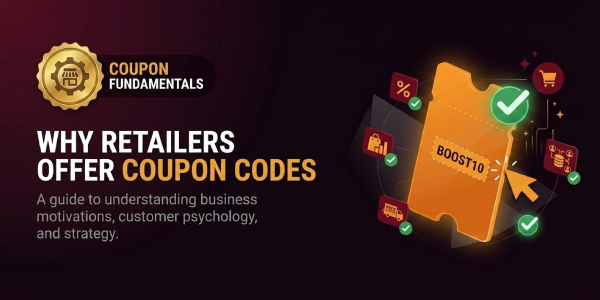
- Retailers use coupon codes as marketing tools rather than simply giving away profits.
- Discounts help attract new customers who may otherwise shop with competitors.
- Coupon codes can increase average order value by encouraging shoppers to spend more.
- Retailers often use promotions to reduce cart abandonment and recover lost sales.
- Coupon campaigns help brands clear inventory, launch products, and drive seasonal demand.
- Loyalty-based coupon offers encourage repeat purchases and long-term customer retention.
- Understanding why retailers offer discounts helps shoppers recognize when and where the best savings opportunities appear.
Most shoppers see coupon codes as a simple way to save money.
Retailers see them very differently.
Behind every discount code is a carefully planned business strategy designed to attract customers, increase revenue, improve customer retention, or move inventory.
At first glance, offering discounts may seem counterproductive. Why would a retailer willingly reduce the amount customers pay?
The answer is that coupon codes are often one of the most effective marketing tools available to online stores.
When used strategically, a discount can generate more revenue than it costs.
Understanding why retailers offer coupon codes provides valuable insight into how modern ecommerce works and can help shoppers identify the best opportunities to save.
Quick Answer: Retailers offer coupon codes to attract new customers, increase sales, encourage larger purchases, reduce cart abandonment, promote products, clear inventory, build email or loyalty audiences, and encourage repeat purchases. The discount may reduce margin on one order, but the campaign can still be worthwhile if it improves conversion, average order value, customer acquisition, or long-term retention.
Coupon Codes Are Marketing Tools
One of the biggest misconceptions about coupon codes is that retailers create them simply to be generous.
In reality, discounts are marketing investments.
Retailers analyze customer behavior and use promotions to influence purchasing decisions.
A coupon code can encourage someone who is undecided to complete a purchase.
From the retailer's perspective, a discounted sale is often better than no sale at all.
This is especially true in highly competitive industries where shoppers can compare prices within seconds.
Attracting New Customers
Acquiring new customers is expensive.
Retailers invest heavily in:
- Advertising
- Social media marketing
- Search engine optimization
- Influencer partnerships
- Email campaigns
Coupon codes help reduce the risk for first-time buyers.
A shopper who has never purchased from a brand before may hesitate because they are unfamiliar with:
- Product quality
- Shipping speed
- Customer service
- Return policies
A discount helps overcome that hesitation.
This is why many retailers offer promotions such as:
- 10% off your first order
- 15% off for new customers
- Free shipping on your first purchase
The goal is simple: convert visitors into customers.
Increasing Average Order Value
Retailers don't just want customers to buy.
They want customers to spend more.
Coupon codes are often structured to encourage larger purchases.
Examples include:
- Spend $50, save $10
- Spend $100, save 20%
- Free shipping on orders over $75
These promotions motivate shoppers to add extra items to their cart.
A customer planning to spend $85 may increase their order to $100 to unlock a bigger discount.
As a result, the retailer generates additional revenue despite offering savings.
Reducing Cart Abandonment
Cart abandonment is one of the biggest challenges in ecommerce.
Millions of shoppers add products to their carts but never complete checkout.
Common reasons include:
- Unexpected shipping costs
- Price concerns
- Comparison shopping
- Purchase hesitation
Retailers often use coupon codes to recover these lost sales.
For example, a shopper may leave a website without purchasing.
A few hours later, they receive an email offering:
"Complete your order and save 10%."
That small incentive is often enough to convert a lost sale into a completed purchase.
Competing in Crowded Markets
Online shoppers have more options than ever before.
A customer searching for a product may compare prices across dozens of retailers within minutes.
Coupon codes help brands remain competitive.
Even if multiple retailers sell similar products, a discount can influence where a customer ultimately purchases.
This is especially common in industries such as:
- Fashion
- Beauty
- Electronics
- Home goods
- Sporting equipment
In highly competitive markets, promotions can be the deciding factor.
Encouraging Repeat Purchases
For many retailers, customer retention is more valuable than customer acquisition.
Existing customers already know the brand.
They are more likely to purchase again.
Retailers often use coupon codes to encourage repeat business.
Examples include:
- Thank-you discounts
- Loyalty rewards
- Birthday coupons
- VIP member promotions
These offers help strengthen customer relationships and increase lifetime value.
A customer who returns regularly is often far more profitable than a one-time buyer.
Clearing Excess Inventory
Not every product sells as quickly as retailers expect.
When inventory accumulates, businesses must create space for new products.
Coupon codes help accelerate sales of slower-moving merchandise.
Common examples include:
- End-of-season products
- Older collections
- Discontinued items
- Overstock inventory
Rather than allowing products to sit in warehouses, retailers use promotions to move inventory efficiently.
Promoting New Products
Discounts are also useful when launching new products.
Customers may be reluctant to try something unfamiliar.
A coupon creates a lower-risk opportunity.
Retailers often use promotions such as:
- Launch discounts
- Early-access pricing
- Limited-time introductory offers
These campaigns generate interest while helping retailers gather customer feedback and sales momentum.
Building Email Lists
Email marketing remains one of the most effective channels in ecommerce.
As a result, many retailers offer discounts in exchange for newsletter subscriptions.
Examples include:
- Sign up and save 10%
- Join our email list for 15% off
- Get exclusive offers delivered to your inbox
While the customer receives a discount, the retailer gains a valuable marketing asset.
Email subscribers can be reached repeatedly without relying on paid advertising.
Creating Urgency
Many coupon campaigns are intentionally time-sensitive.
Examples include:
- Ends tonight
- 24-hour flash sale
- Weekend-only promotion
These limitations encourage shoppers to act quickly.
Without urgency, customers may postpone purchasing indefinitely.
Retailers use limited-time offers to increase conversion rates and accelerate sales.
Supporting Seasonal Sales Events
Major shopping events are built around promotions.
Examples include:
- Black Friday
- Cyber Monday
- Back-to-School sales
- Memorial Day sales
- Labor Day sales
- Holiday shopping events
During these periods, shoppers actively expect discounts.
Retailers use coupon codes to stand out among competitors and capture a larger share of seasonal spending.
Why Retailers Don't Offer Discounts All the Time
If coupon codes are so effective, why doesn't every retailer offer them continuously?
There are several reasons.
Protecting Profit Margins
Discounts reduce revenue per order.
Offering them constantly can hurt profitability.
Preserving Brand Value
Luxury and premium brands often avoid frequent promotions because excessive discounting can weaken brand perception.
Training Customers to Wait
If shoppers expect discounts every week, they may stop purchasing at full price.
Retailers must balance promotional activity carefully.
What This Means for Shoppers
Understanding retailer motivations can help shoppers make smarter decisions.
For example:
- First-order discounts often provide the highest savings.
- Seasonal sales usually feature stronger promotions.
- Abandoned-cart offers may appear after leaving products in a cart.
- Loyalty programs often unlock exclusive discounts.
By recognizing these patterns, shoppers can anticipate promotions rather than simply hoping to find them.
Wrapping Up
Coupon codes are far more than simple discounts. They are strategic marketing tools that help retailers attract customers, increase sales, promote products, clear inventory, and build long-term loyalty. While shoppers benefit from immediate savings, retailers use promotions to achieve specific business goals. Understanding these motivations can help consumers recognize when discounts are most likely to appear and make better purchasing decisions throughout the year.Frequently Asked Questions
Why do retailers offer coupon codes?
Retailers use coupon codes to attract customers, increase sales, encourage larger purchases, and improve customer retention.
Do retailers lose money when offering discounts?
Not necessarily. While profit margins may decrease on individual orders, promotions often increase total revenue by generating more sales.
Why do stores offer discounts to new customers?
First-order discounts reduce purchase hesitation and help retailers acquire new customers.
Why do retailers send coupons by email?
Email coupons encourage purchases while helping retailers build and maintain direct relationships with customers.
Do coupon codes help reduce cart abandonment?
Yes. Many retailers use discounts to encourage shoppers to complete purchases they initially abandoned.
Why do retailers run seasonal promotions?
Seasonal sales help retailers attract shoppers during major buying periods and compete more effectively.
Why don't all brands offer coupon codes?
Some brands prioritize premium positioning, profit margins, or pricing consistency over promotional discounts.
 1StopLighting
 24Station
 25home
 945Industries
 ABC Wigs
 Abelssoft
 Abracadabra NYC
 Adorime