

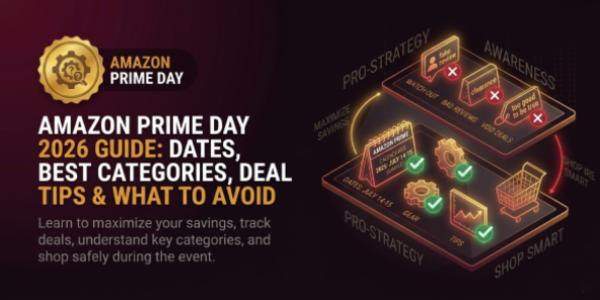
- Prime Day 2026 runs from June 23 through June 26.
- Early Prime Day deals are already live, but not every early deal is worth buying immediately.
- The strongest Prime Day categories usually include Amazon devices, home essentials, apparel, beauty, electronics, school supplies, and small appliances.
- Shoppers should verify discounts using price history, competitor pricing, seller quality, return terms, and final checkout cost.
- Walmart Deals and Target Circle Deal Days overlap with Prime Day, so Amazon is not the only retailer worth checking.
- Prime Day can be useful for back-to-school shopping because the 2026 event falls in late June.
- The smartest Prime Day strategy is to shop from a list, compare prices, and avoid buying only because a countdown timer creates urgency.
Amazon Prime Day is no longer just a short Amazon sale for people who want a discounted Echo speaker. It has become one of the biggest online shopping moments of the year, with early deals, Lightning Deals, competing retailer events, Prime-only offers, credit card promotions, grocery discounts, back-to-school savings, and price drops across dozens of categories.
That also makes it easier to overspend.
A good Prime Day plan is not about chasing every “limited-time” badge you see. It is about knowing what is actually worth buying, checking whether the discount is real, comparing other retailers, and avoiding the products that only look cheaper because of clever sale presentation.
At DealsDasher, we treat Prime Day as a shopping strategy event, not just a deals event. This guide explains the 2026 dates, what changed this year, the best categories to watch, what to avoid, how to verify real savings, and how to compare Amazon with Walmart, Target, Best Buy, and other retailers before you check out.
Quick Answer: What Should Shoppers Know About Prime Day 2026?
Amazon Prime Day 2026 runs from June 23 through June 26. Prime members get access to four days of major deals across Amazon devices, electronics, home goods, beauty, fashion, groceries, school supplies, and more. Early deals are already available, but shoppers should compare prices before buying because not every advertised discount is automatically the best price.
The simplest rule is this: Prime Day is worth shopping when the item was already on your list, the current price is lower than its recent price history, and the final checkout price beats competing retailers. If a deal only looks good because of a high list price, short timer, or vague percentage discount, slow down before buying.
For shoppers mainly looking for Amazon-specific savings, the Amazon coupon codes page is a useful place to check before Prime Day because Amazon savings often come through a mix of automatic discounts, clipped coupons, limited-time offers, and product-specific promotions.
When Is Amazon Prime Day 2026?
Amazon Prime Day 2026 runs from Tuesday, June 23 through Friday, June 26. The event starts at 12:01 a.m. Pacific Time on June 23 and runs for four days, making it longer than the original one-day version that Amazon launched years ago.
The June timing matters. Prime Day has often been associated with July, but in 2026 it falls earlier, which puts it closer to summer shopping, travel preparation, and early back-to-school planning. That means the best opportunities may not only be in tech. Household supplies, dorm essentials, apparel, school gear, beauty basics, and kitchen products may matter just as much as headphones and smart speakers.
If you are planning bigger purchases, it is worth checking competing sales too. Walmart is running a major summer savings event around the same window, so shoppers comparing Amazon against Walmart coupon codes may find that one retailer wins on price while another wins on shipping, pickup, return convenience, or available inventory.
What Changed for Prime Day 2026?
The biggest change is timing. Prime Day 2026 is happening in late June instead of the more familiar July window. That changes shopper behavior because the event now overlaps more directly with summer refreshes, early school shopping, vacation supplies, outdoor purchases, and mid-year household restocking.
The second major change is how shoppers research deals. More people now use AI assistants, browser tools, price trackers, shopping apps, and comparison pages before buying. That means the winning Prime Day strategy is not simply “open Amazon and sort by discount.” Smart shoppers are asking better questions: Is this the lowest price? Is the seller reliable? Will this be cheaper on Black Friday? Is the same product available at Target or Best Buy? Is the coupon applied at checkout?
This is also why DealsDasher’s guide on how coupons are verified is especially relevant during Prime Day. The same thinking applies to seasonal deals: a discount should be checked against terms, expiry, product eligibility, price history, and whether the final cart price actually changed.
How Does Prime Day Work?
Prime Day is Amazon’s annual deal event for Prime members. It includes several types of promotions, and understanding the difference can help you avoid confusion at checkout.
Some Prime Day discounts are automatic. You see the lower price on the product page, add the item to your cart, and the sale price is already included. Other offers require you to clip a coupon checkbox on the product page. Some are Lightning Deals with limited time or limited quantity. Others are brand promotions, bundle offers, Subscribe & Save discounts, credit card incentives, or gift card offers.
That is why two shoppers can see similar products but get different final prices. One may have clipped a coupon. Another may be eligible for a Prime-only promotion. Someone else may be buying from a third-party seller with different shipping or return terms.
For broader shopping categories beyond Amazon, DealsDasher’s Electronics & Gadgets discounts page can help shoppers compare tech-focused offers across different stores instead of assuming Amazon is always the cheapest option.
Do You Need Amazon Prime to Shop Prime Day?
Most major Prime Day deals are designed for Amazon Prime members. Some early deals or regular sale prices may be visible to non-members, but the strongest Prime Day offers usually require Prime access.
That does not automatically mean every shopper should pay for Prime just for the event. It depends on what you plan to buy. If you already have several planned purchases, expect to use fast shipping, stream Prime Video, or shop Amazon frequently, a membership may make sense. If you only want one small item, the savings may not justify the membership cost unless you are eligible for a trial or discounted plan.
Students, young adults, and eligible lower-income shoppers may have access to discounted Prime options, so it is worth checking your eligibility before paying full price. But the more important question is not “Can I join Prime?” It is “Will the Prime-only savings beat what I could get elsewhere?”
For shoppers who are comparing membership-driven offers with regular retail deals, the Target coupon codes page can be useful because Target often runs its own Circle promotions during the same seasonal shopping window.
Are Early Prime Day Deals Worth Buying?
Early Prime Day deals can be worth buying, but only when the price is already strong and the item is something you actually planned to purchase. The problem with early deals is that they create uncertainty. Some prices may stay the same during Prime Day. Some may drop further. Some may sell out before the official event starts.
Buy early when the product is a household essential, a recurring purchase, a known brand with stable pricing, or an item you need before June 23. It can also make sense to buy early if price history shows the current price is already near its lowest recent point.
Wait when the item is expensive, tech-heavy, model-sensitive, or likely to receive deeper event-day discounts. Laptops, TVs, tablets, premium headphones, robot vacuums, cameras, and appliances deserve more patience unless the early price is clearly strong.
Home products are a good example. If you see a practical storage item, bedding set, cleaning tool, or kitchen accessory at a verified low price, buying early may be fine. But for larger purchases, comparing against Home & Garden discounts can help you decide whether Amazon is genuinely leading the market or simply getting your attention first.
What Are the Best Things to Buy on Prime Day?
The best Prime Day purchases are usually items with clear price history, repeat demand, strong brand competition, and broad retailer participation. In plain English: buy things you already understand, already need, and can compare easily.
Strong Prime Day categories often include:
- Amazon devices: Echo speakers, Fire TV devices, Kindle e-readers, Ring doorbells, Blink cameras, and Eero routers often receive prominent discounts because Amazon controls the ecosystem.
- Household essentials: Cleaning supplies, paper products, laundry items, batteries, storage items, and basic home goods can be useful if you are restocking items you already use.
- Beauty and personal care: Skincare, hair tools, grooming devices, oral care, and everyday beauty products can be good buys, especially when brand coupons stack with sale prices.
- Fashion and apparel: Shoes, basics, activewear, seasonal clothing, and accessories can be worth checking, but sizing and return terms matter.
- Small appliances: Air fryers, coffee makers, blenders, vacuums, steamers, and kitchen tools often receive attention during Prime Day.
- Back-to-school and office supplies: Notebooks, backpacks, calculators, tablets, desks, chairs, printers, and dorm supplies can be especially relevant because Prime Day 2026 falls in late June.
- Pet supplies: Food, treats, grooming tools, beds, and toys can be useful if the price beats your normal subscription or local store price.
The safest category strategy is to start with essentials and planned purchases before browsing wants. For fashion shoppers, the Fashion & Apparel discounts page can help compare Prime Day clothing offers with other retailers that may have better size availability, easier returns, or stronger seasonal clearance.
Is Prime Day Good for Electronics?
Prime Day can be good for electronics, but it is also one of the categories where shoppers need to be most careful. Electronics can look deeply discounted because of inflated list prices, older model numbers, renewed products, bundle pricing, or third-party seller promotions.
The best electronics to watch are usually headphones, earbuds, smart home devices, streaming devices, monitors, chargers, power banks, computer accessories, tablets, and Amazon-owned devices. These products are easier to compare and often have enough sales history to judge whether the price is truly low.
Be more cautious with unknown-brand laptops, ultra-cheap projectors, no-name tablets, random smartwatches, and electronics with vague specifications. A cheap device is not always a good deal if the warranty is weak, the reviews are thin, or the product is an older model being cleared out.
If you are shopping for tech, compare Amazon’s price with Best Buy coupon codes and current Best Buy offers before checking out. Best Buy may be stronger for open-box options, warranties, store pickup, laptops, TVs, and major electronics where after-sale support matters.
Is Prime Day Good for Beauty and Personal Care?
Prime Day can be a strong time to buy beauty and personal care products, especially if you are restocking items you already use. Skincare, haircare, electric toothbrushes, grooming tools, sunscreen, makeup, razors, and wellness basics often appear in seasonal promotions.
The key is to avoid buying beauty products from questionable sellers. Check who is selling and shipping the item, read recent reviews, watch for packaging complaints, and be careful with products where freshness or authenticity matters. A low price is not enough if the product is expired, damaged, poorly stored, or not from a reliable source.
For beauty shoppers, Prime Day is best for repeat purchases and known brands. It is less ideal for experimenting with expensive skincare unless reviews, return terms, and seller quality are clear.
Before building your cart, compare Amazon offers with Beauty & Personal Care discounts because brand-direct retailers and specialty beauty stores may offer better samples, loyalty points, bundles, or free gifts.
Is Prime Day Good for Back-to-School Shopping?
Prime Day 2026 is especially relevant for back-to-school shopping because it lands before many families begin their main school supply runs. That makes it a useful time to buy early essentials without waiting for late-summer pressure.
Good back-to-school Prime Day buys may include backpacks, lunchboxes, notebooks, pens, pencils, calculators, tablets, dorm bedding, desk lamps, storage bins, headphones, printers, chargers, and small appliances for dorm rooms. Families can also watch for cleaning supplies, snacks, water bottles, and basic clothing.
The mistake is buying everything from one retailer. Amazon may be strong for convenience and selection, but Walmart and Target can be better for school supply bundles, pickup, grocery add-ons, and local availability. For older students or home office setups, DealsDasher’s Office, School & Business discounts page can help connect Prime Day planning with other stores that specialize in school, work, software, and productivity products.
What Should You Avoid Buying on Prime Day?
Avoid buying anything simply because it has a large percentage discount. That is the fastest way to turn Prime Day into expensive clutter.
Be cautious with:
- Products with inflated list prices: A product marked “50% off” may not be a real bargain if the list price was never the normal selling price.
- Unknown electronics brands: Cheap tech can be tempting, but poor support, weak warranties, and inconsistent quality can erase the savings.
- Bundles you do not need: A bundle is only valuable if every included item has a purpose.
- Products with poor recent reviews: Older positive reviews can hide recent quality drops.
- Fashion with difficult returns: Clothing deals lose value if sizing is unreliable and return terms are inconvenient.
- Large purchases without comparison: TVs, laptops, appliances, furniture, and fitness equipment should always be checked against competitors.
- Subscription traps: Subscribe & Save can be useful, but only if you actually want repeat deliveries.
Coupon confusion is another issue. If you have ever wondered why a discount disappears at checkout, DealsDasher’s guide on why coupon codes stop working explains common problems like exclusions, expired offers, minimum spends, account restrictions, and product eligibility.
How Can You Tell If a Prime Day Deal Is Real?
A real Prime Day deal should pass five checks.
First, check price history. Look at whether the current price is lower than the recent average, not just lower than the list price. Amazon’s own price history tool can help on supported products, and third-party trackers can add more context.
Second, compare competitors. Search the same product at Walmart, Target, Best Buy, eBay, and brand-direct stores. The best deal is the best final cost, not the best-looking badge.
Third, check the seller. On Amazon, the seller and shipping source matter. “Sold by Amazon” and reputable brand stores are generally easier to trust than unfamiliar third-party sellers with limited history.
Fourth, review the return terms. A $40 discount is not worth much if returns are difficult, shipping is expensive, or the item is final sale.
Fifth, check the final checkout price. Coupons, taxes, shipping, gift card promos, and membership discounts can change the actual amount you pay.
A simple rule: if the price still looks good after you compare it, check history, review the seller, and confirm the final cart total, it is probably a stronger deal than one that only looks impressive on the product page.
If you are stacking discounts, DealsDasher’s guide to stacking coupon codes and discounts is a useful companion because Prime Day savings often come from combining sale prices, clipped coupons, gift card offers, cashback, and card rewards.
Amazon Prime Day vs Walmart Deals vs Target Circle Deal Days
Prime Day is the headline event, but Amazon is not shopping alone. Walmart and Target usually run major competing sales during the same window, and in 2026 both are directly overlapping with Prime Day.
Here is the practical difference:
- Amazon Prime Day is usually best for Amazon devices, marketplace selection, fast shipping, tech accessories, home basics, beauty, books, and product variety.
- Walmart Deals can be stronger for groceries, household essentials, toys, school supplies, patio furniture, appliances, and shoppers who prefer store pickup.
- Target Circle Deal Days can be strong for apparel, beauty, home, toys, baby items, school supplies, essentials, and shoppers who use Target Circle offers.
- Best Buy can be stronger for TVs, laptops, gaming gear, open-box electronics, warranties, and local pickup.
The smartest approach is to compare by category. Amazon may win on a Kindle. Walmart may win on school basics. Target may win on clothing or home essentials. Best Buy may win on a laptop. There is no single best retailer for every product.
For shoppers who want to compare Amazon’s sale with Target’s overlapping event, Target coupon codes can help identify whether Target Circle offers, gift card promos, or category discounts beat the Prime Day price.
Should You Wait for Black Friday Instead?
Sometimes yes. Prime Day is not automatically the best sale of the year for every product.
Prime Day is usually better when you want Amazon devices, household restocks, summer items, back-to-school products, beauty basics, smart home gear, small appliances, and mid-year essentials.
Black Friday may be better for TVs, major appliances, gaming consoles, premium laptops, holiday gifts, winter clothing, large furniture, and broader retailer competition. Cyber Monday may be better for software, subscriptions, online services, digital tools, and web-based products.
The decision depends on timing. If you need the product now and Prime Day offers a verified low price, buy it. If the product is expensive and not urgent, waiting for Black Friday may be smarter.
For shoppers who are comparing seasonal sales across many online stores, Food, Grocery & Delivery discounts can also be useful during Prime Day week because household restocking and grocery-adjacent offers often appear across multiple retailers, not only Amazon.
How to Build a Prime Day Shopping List
The best Prime Day shoppers make a list before the sale starts. That sounds simple, but it prevents most impulse purchases.
Start with items you already planned to buy in the next 30 to 90 days. Then separate them into three groups:
- Need now: household essentials, school supplies, replacement chargers, work items, pet supplies, groceries, and personal care products.
- Buy if the price is right: headphones, small appliances, clothing basics, smart home devices, bedding, and kitchen tools.
- Wait unless the deal is excellent: laptops, TVs, furniture, premium appliances, cameras, gaming gear, and expensive beauty devices.
Write down the normal price before Prime Day. This gives you a reference point when the sale starts. If an item usually costs $79 and the Prime Day price is $72, that may not be worth rushing. If it usually costs $79 and drops to $49 from a reputable seller, that is a very different situation.
For families shopping ahead, the Baby, Kids & Family discounts page can help compare Prime Day child-focused offers with stores that may be stronger for baby gear, toys, family essentials, and school-season products.
Prime Day Coupon Strategy: Codes, Clipped Coupons, Cashback and Cards
Prime Day is not only about visible sale prices. Extra savings can come from several places.
- Amazon coupons: Some products have a coupon checkbox near the price. You usually need to clip it before adding the item to your cart.
- Promo codes: Some sellers offer codes, but Amazon is less code-heavy than traditional retail sites.
- Subscribe & Save: Useful for repeat purchases like household products, pet supplies, and personal care, but only if you remember to manage future deliveries.
- Cashback portals: Some purchases may qualify through cashback sites, although Amazon category eligibility can be limited.
- Credit card rewards: Prime Visa and other cards may offer extra value, but only if you avoid carrying a balance.
- Gift card promotions: Sometimes retailers offer bonuses when buying or using gift cards.
The important part is checking the final cart price. A deal that says “20% off” may be less valuable than a smaller discount that stacks with a coupon, reward, or gift card offer.
If you are new to coupon mechanics, DealsDasher’s guide on what one coupon per customer means is helpful because many Prime Day-style promotions include limits, account restrictions, single-use conditions, and product-specific rules.
Prime Day Shipping, Returns and Hidden Costs
A Prime Day deal should not be judged by product price alone. Shipping speed, return convenience, seller reliability, warranty coverage, installation needs, and replacement options all matter.
Before buying, check:
- Who sells the item.
- Who ships the item.
- Whether returns are free.
- How long the return window lasts.
- Whether the product is new, renewed, refurbished, open-box, or used.
- Whether warranty support comes from the brand, Amazon, or the seller.
- Whether accessories are included.
- Whether the product works in your country or region.
These details matter most for electronics, appliances, furniture, fitness equipment, beauty devices, baby gear, and third-party marketplace products.
If you are open to buying from multiple retailers, the eBay coupon codes page can be useful for comparing open-box, refurbished, certified, or marketplace-style deals against Amazon’s Prime Day prices.
Prime Day Deal Checklist Before You Buy
Before you check out, ask these questions:
- Was this item already on my list?
- Is the current price lower than its recent selling price?
- Have I compared at least two other retailers?
- Is the seller reliable?
- Are reviews recent and believable?
- Is the return policy reasonable?
- Did I clip any available coupon?
- Did the discount apply at checkout?
- Would I still buy this without the countdown timer?
- Can I afford this without carrying debt?
This checklist turns Prime Day from a browsing session into a controlled shopping plan. It also helps you avoid one of the biggest Prime Day traps: saving money on things you never needed.
For health, wellness, and personal care purchases, it is especially important to check seller quality and product details. DealsDasher’s Health & Wellness discounts page can help shoppers compare wellness-related offers across stores where authenticity, freshness, and product terms matter.
Common Prime Day Mistakes to Avoid
The most common Prime Day mistake is treating every discount as urgent. Retailers use timers, badges, limited-stock warnings, and big percentage claims because they work. That does not mean every offer deserves your money.
Another mistake is ignoring other retailers. Walmart, Target, Best Buy, eBay, brand websites, and specialty stores can beat Amazon depending on the product. Even when the price is the same, another retailer may offer better pickup, returns, bundles, rewards, or warranty support.
A third mistake is forgetting that cheap is not the same as valuable. A low-quality product at 60% off can still be a bad purchase. This is especially true for electronics, home appliances, fashion, furniture, and beauty tools.
Shoppers also forget to check coupon terms. Minimum order values, product exclusions, seller restrictions, account limits, subscription terms, and expiry times can all affect whether a deal works.
For entertainment products, toys, games, and streaming-related purchases, DealsDasher’s Gaming & Entertainment discounts page can help compare Prime Day offers with category-specific stores and other seasonal promotions.
Final Prime Day 2026 Shopping Strategy
The best Prime Day strategy is simple: plan first, compare second, buy last.
Start with a list of items you already need. Check normal prices before the event. During Prime Day, compare Amazon against Walmart, Target, Best Buy, eBay, and brand websites. Use price history where available. Watch the final checkout price, not just the advertised discount. Avoid products that rely on urgency more than value.
Prime Day can be genuinely useful for Amazon devices, household essentials, beauty, apparel, smart home products, back-to-school supplies, small appliances, and everyday restocks. It is less reliable for random marketplace products, unknown electronics, impulse fashion, vague bundles, and expensive purchases that you have not researched.
A good deal should make sense even after the timer disappears. If the product fits your needs, the price checks out, the seller is reliable, and the final cost beats your alternatives, Prime Day can be a smart time to buy.
If not, skip it. The best money you save during Prime Day may come from the deals you decide not to chase.
FAQs About Amazon Prime Day 2026
When is Amazon Prime Day 2026?
Amazon Prime Day 2026 runs from June 23 through June 26. The sale starts at 12:01 a.m. Pacific Time on June 23 and lasts four days. Early deals are already available before the official event.
Do I need Amazon Prime to shop Prime Day?
Most Prime Day deals are made for Prime members. Some regular discounts may be visible to non-members, but the strongest Prime Day offers usually require a Prime membership, free trial, or eligible discounted Prime plan.
Are early Prime Day deals worth buying?
Early Prime Day deals are worth buying when the price is already low, the item is something you planned to buy, and price history supports the discount. For expensive tech, TVs, laptops, and appliances, it may be better to wait unless the early price is clearly strong.
What are the best things to buy on Prime Day?
The best Prime Day buys usually include Amazon devices, household essentials, beauty products, apparel, smart home devices, small appliances, school supplies, pet products, and everyday restocks. The strongest deals are usually on items with clear price history and strong retailer competition.
What should I not buy on Prime Day?
Avoid unknown electronics, inflated list-price deals, unnecessary bundles, products with poor recent reviews, hard-to-return fashion, and large purchases you have not compared elsewhere. A deal is not good just because the discount percentage looks high.
Is Prime Day better than Black Friday?
Prime Day can be better for Amazon devices, household essentials, summer items, back-to-school products, and smart home gear. Black Friday may be better for TVs, gaming consoles, major appliances, holiday gifts, and premium electronics.
Can I stack coupons on Prime Day?
Sometimes. Prime Day savings may stack with clipped coupons, Subscribe & Save, gift card offers, cashback, or credit card rewards, but it depends on the product and terms. Always check the final checkout price before assuming multiple discounts applied.
Does Amazon price match Prime Day deals?
Amazon generally does not operate like a traditional price-match retailer during Prime Day. Instead of relying on price matching, shoppers should compare prices before buying and choose the retailer with the best final cost, return policy, and delivery option.
Are Walmart and Target sales worth checking during Prime Day?
Yes. Walmart Deals and Target Circle Deal Days often overlap with Prime Day and can beat Amazon in certain categories. Walmart may be strong for groceries, school supplies, patio, toys, and household items, while Target may be strong for apparel, beauty, baby, home, and essentials.
How do I know if a Prime Day deal is real?
Check price history, compare competitors, review the seller, read recent reviews, confirm return terms, and look at the final checkout price. A real deal should still look good after those checks, not just on the product page.
 Amazon
 Best Buy
 eBay
eBay
 Target
 Walmart