

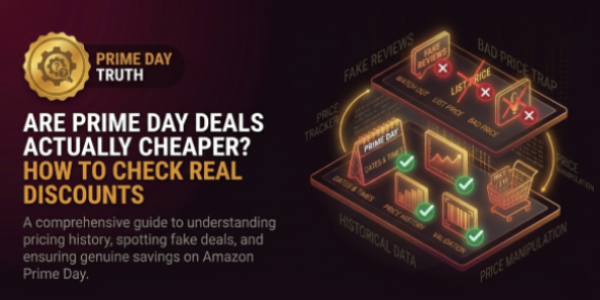
- Some Prime Day deals are genuinely cheaper, but shoppers should verify them before buying.
- The displayed percentage discount is less important than the recent selling price.
- Price history, competitor comparison, seller quality, return terms, and final checkout price matter most.
- Amazon devices, household essentials, beauty, and repeat-purchase products are often safer to judge than random marketplace electronics.
- Walmart, Target, Best Buy, eBay, and brand-direct stores can sometimes beat Amazon during Prime Day week.
- Shoppers should watch for inflated list prices, weak reviews, unclear sellers, unnecessary bundles, and countdown-driven impulse buying.
- The best Prime Day deal is one that still looks good after the timer disappears.
Prime Day can absolutely have real discounts. It can also have deals that look better than they are.
That is the problem shoppers run into every year. A product says “40% off.” A timer says the deal is ending soon. The badge says “Prime Day Deal.” The price looks lower than usual, and the page is designed to make you move quickly. But none of that proves the discount is actually meaningful.
A real Prime Day deal is not just a product with a crossed-out price. It is a product that is cheaper than its recent selling price, competitive against other retailers, sold by a reliable seller, easy to return if something goes wrong, and still worth buying after you remove the urgency from the page.
This guide focuses on the question shoppers care about most: how do you know whether a Prime Day deal is actually cheaper? If you are interested in learning what to shop for in the Prime Day sales, our full Amazon Prime Day 2026 guide is a must-read.
Quick Answer: Are Prime Day Deals Actually Cheaper?
Some Prime Day deals are genuinely cheaper, especially on Amazon devices, household essentials, beauty products, apparel, smart home gear, school supplies, and select electronics. But not every Prime Day discount is automatically a good deal. To verify a real discount, compare the current price with recent price history, check other retailers, review the seller, confirm the coupon or offer applied, and look at the final checkout price.
The easiest mistake is trusting the percentage-off label without checking what the item usually sells for. A product marked 50% off a high list price may only be a few dollars cheaper than its normal selling price. A smaller-looking discount, on the other hand, may be excellent if it beats the product’s recent low.
That is why Prime Day shopping should start with comparison, not excitement. If you want a broader deal-hunting starting point beyond Amazon, DealsDasher can help you compare coupon pages, category discounts, and retailer offers before assuming one sale has the best price.
Why Prime Day Discounts Can Be Confusing
Prime Day discounts are confusing because Amazon uses several types of offers at once. Some products have automatic markdowns. Some require you to clip a coupon checkbox. Some are Lightning Deals with limited time or limited inventory. Some come from Amazon directly, while others come from third-party sellers. Some are tied to Prime membership, Subscribe & Save, card rewards, or gift card promotions.
This creates a messy shopping environment. Two similar products may have different sellers, different warranties, different shipping terms, and different coupon rules. A shopper may see a low price on the product page but lose the discount if they forget to clip a coupon or choose the wrong variation. Another shopper may see a high percentage discount on an item that was already selling near that price before the event.
The crossed-out price is especially tricky. It may reflect a list price, suggested retail price, previous price, or another reference point. That does not always mean it was the everyday price shoppers were paying last week.
A discount should be judged by whether it works, what terms apply, and whether it actually lowers the final amount a shopper pays.
What Counts as a Real Prime Day Deal?
A real Prime Day deal is a discount that beats the product’s recent normal price and gives shoppers better value than they could reasonably get elsewhere.
That definition matters because “on sale” and “good deal” are not the same thing. A product can be on sale every week. A seller can reduce a price from an inflated list price. A discount can look huge while the actual savings are small. A bundle can look valuable while including extras you do not need.
A real deal usually meets most of these conditions:
- The current price is lower than the item’s recent average selling price.
- The product is from a reliable brand or seller.
- The discount applies to the exact model, size, color, or variation you want.
- The final checkout price reflects the advertised savings.
- The product has reasonable return terms.
- The price is competitive with Walmart, Target, Best Buy, eBay, or the brand’s own website.
- You were already considering the item before the deal appeared.
This is especially important on marketplace-heavy products. For example, if you are comparing Amazon offers against other large retailers, the Amazon coupon codes page is a better place to start than randomly trusting a product badge because it keeps the focus on actual available savings, not just the look of a product listing.
The 7-Step Prime Day Real Deal Test
The best way to check a Prime Day deal is to slow the purchase down. You do not need a complicated spreadsheet. You only need a simple test before checkout.
1. Check recent price history
Look at whether the current Prime Day price is lower than the item’s recent selling price. The list price is less useful than the actual price shoppers have been paying over the past few weeks or months.
If a product was usually $79 and drops to $49, that may be a real deal. If it was usually $59 and now says $49 with a dramatic “was $99” label, the savings are smaller than they look.
2. Compare at least two other retailers
Search the same model at Walmart, Target, Best Buy, eBay, and the brand’s own website. A Prime Day deal is stronger when Amazon has the best final price, not just the loudest sale badge.
3. Check the exact product variation
A discount may apply only to one color, size, bundle, generation, storage capacity, or seller option. Make sure the deal applies to the version you actually want.
4. Review the seller and shipping source
On Amazon, the seller matters. A product sold by Amazon, the official brand store, or a known retailer is usually easier to trust than a third-party seller with limited history.
5. Read recent reviews
Do not only look at the average star rating. Read recent reviews to see if quality, packaging, shipping, or authenticity complaints are increasing.
6. Check return terms and warranty
A discount loses value if the return window is difficult, the product is final sale, or the warranty support is unclear.
7. Confirm the final checkout price
Coupons, taxes, shipping, rewards, gift cards, and Subscribe & Save can all change the final number. The price that matters is the one you pay at checkout.
When comparing Amazon with broader retail deals, the Walmart coupon codes page is worth checking because Walmart often runs overlapping summer deals that can beat Amazon on groceries, essentials, school supplies, pickup convenience, and household items.
Why Price History Matters More Than the Discount Percentage
The discount percentage is one of the least reliable ways to judge a Prime Day deal. It is useful at a glance, but it does not tell the full story.
A product marked 60% off may be discounted from a list price that shoppers rarely paid. A product marked 15% off may be at its lowest price of the year. The percentage only matters when you know what the item usually sells for.
Price history helps answer a better question: is today’s price lower than the price this product had before Prime Day hype started?
For expensive items, check at least the last 90 days if possible. For tech, appliances, and seasonal products, looking back further can be helpful because prices may fluctuate around major sales events. For everyday essentials, you may already know the normal price from your own past purchases.
This is one reason the “real discount” check is different by category. A $5 drop on a household product you buy monthly may be useful. A $20 drop on a laptop may be meaningless if the same laptop was $50 cheaper last month.
For tech-heavy purchases, browse current Electronics & Gadgets discounts before making a Prime Day decision because electronics prices can shift quickly across Amazon, Best Buy, brand stores, software retailers, and direct-to-consumer tech brands.
Should You Trust the “Was Price” on Prime Day?
You should treat the “was price” as a clue, not proof.
The “was price” or crossed-out price can help you understand how a retailer is presenting the discount, but it does not always represent the recent everyday selling price. Sometimes it reflects a manufacturer’s suggested retail price. Sometimes it reflects a previous price. Sometimes the product has been selling below that amount for a long time.
This does not mean every crossed-out price is misleading. Many are legitimate reference points. But shoppers should not rely on them alone.
The better question is: what did this product cost before Prime Day, and what does it cost elsewhere right now?
If the sale price is lower than recent history and lower than competing retailers, the deal is much more trustworthy. If the crossed-out price is the only thing making the discount look impressive, be careful.
This is especially relevant for categories like apparel, home goods, and beauty, where list prices and seasonal markdowns can vary widely. Before buying clothing or accessories, compare Prime Day pricing with Fashion & Apparel discounts to see whether Amazon is actually beating brand-direct or fashion-focused retailers.
Red Flags That a Prime Day Deal May Not Be Worth It
Not every bad deal looks bad. Many weak Prime Day offers are packaged to look urgent, exclusive, or unusually generous. Here are the warning signs to watch.
The discount is based on a suspiciously high list price
If the product says it is 70% off but the “was” price looks unrealistic, check price history before buying.
The product has very few recent reviews
A high rating with limited recent feedback can be risky, especially for electronics, beauty devices, appliances, and third-party marketplace products.
The seller is unfamiliar
A low price from an unknown seller can be risky if shipping, returns, authenticity, or warranty support are unclear.
The product details are vague
Be cautious with listings that avoid clear model numbers, technical specs, size charts, material details, or warranty information.
The bundle includes things you do not need
Bundles often look valuable, but only if every included item matters to you.
The timer is doing most of the selling
A countdown timer should not replace comparison. If you would not buy the product without the timer, it may not be a smart purchase.
The deal disappears at checkout
If a coupon, promotional credit, or discount does not apply in the cart, the deal is not what the listing suggested.
For home products, this matters more than shoppers realize. A cheap vacuum, storage unit, bedding set, or small appliance is only useful if it holds up after delivery. Comparing with Home & Garden discounts can help you avoid buying the first home deal that looks urgent.
Are Amazon Devices Usually Real Prime Day Deals?
Amazon devices are often among the more reliable Prime Day discounts because Amazon directly controls the products and uses Prime Day to bring more shoppers into its ecosystem. Echo speakers, Fire TV devices, Kindle e-readers, Ring cameras, Blink security products, and Eero routers often receive visible event pricing.
That does not mean every Amazon device deal is automatically the right buy.
Check whether you are buying the newest generation or an older model. Compare bundles against single-device pricing. Look at whether the accessories included in a bundle are useful. Make sure the device works with your existing setup. And ask whether you actually want the Amazon ecosystem in your home.
For example, a discounted Ring device may be a good deal if you already use Ring products. But if you prefer another smart home platform, the discount may not matter. A cheaper Echo speaker can be useful in a kitchen or bedroom, but only if you already use Alexa.
Prime Day is strong for Amazon devices because the prices often fall sharply. The decision still comes down to fit, not just price.
For shoppers comparing Amazon devices against other smart home products, the Best Buy coupon codes page can help because Best Buy may have strong competing deals on smart speakers, TVs, security cameras, routers, laptops, and entertainment tech.
Are Electronics Prime Day Deals Real?
Some electronics Prime Day deals are real. Others need extra caution.
Electronics are tricky because small model differences can change the value completely. A laptop with less RAM, an older processor, or a lower-quality screen may look similar to a better model. A TV may have the same screen size but weaker refresh rates or fewer gaming features. A pair of headphones may be an older generation with a better-looking discount.
Good electronics deals usually appear on products with clear model numbers, known brands, strong review history, and easy comparison across retailers. Headphones, earbuds, monitors, chargers, streaming devices, tablets, keyboards, mice, routers, and smart home accessories can be good Prime Day buys when the price history checks out.
Be careful with unknown-brand projectors, no-name tablets, suspiciously cheap smartwatches, ultra-low-cost laptops, and accessories with vague specs. These products can look like bargains but disappoint quickly.
A strong electronics deal should answer three questions clearly:
- What exact model am I buying?
- Is the price lower than recent history?
- Would I still choose this product if it were not on sale?
If the answer to any of those is unclear, keep comparing.
For marketplace-style tech and refurbished products, eBay coupon codes can be useful because eBay may offer certified refurbished, open-box, or seller-backed alternatives that compete with Amazon’s Prime Day pricing.
Are Home, Beauty, and Essentials Deals Usually Safer?
Home, beauty, and household essentials can be safer Prime Day categories because shoppers often know the normal prices already. If you buy the same laundry detergent, skincare product, razor blades, pet supplies, batteries, or cleaning products regularly, it is easier to recognize a real discount.
Repeat-purchase categories are less about hype and more about restocking. A modest discount on something you use every month can be more valuable than a dramatic markdown on a gadget you did not need.
Beauty and personal care require a little more caution. Seller quality matters. Check whether the product is sold by Amazon, the brand, or a reputable retailer. Read recent reviews for packaging, freshness, leakage, and authenticity complaints. Be careful with skincare, fragrance, haircare, and wellness products from unknown marketplace sellers.
Home essentials need practical thinking too. A discounted storage bin, sheet set, kitchen tool, or cleaning product is only a good buy if the size, material, and return terms work for your household.
For skincare, haircare, grooming, and personal care purchases, compare Prime Day deals against Beauty & Personal Care discounts because brand-direct stores and specialty retailers may offer better samples, loyalty perks, bundles, or free shipping thresholds.
Are Lightning Deals Better Than Regular Prime Day Deals?
Lightning Deals can be better, but they can also push shoppers into rushed decisions.
A Lightning Deal is usually available for a limited time or limited quantity. That urgency can create genuine savings, especially when the product is already popular and the price history supports the discount. But it can also pressure shoppers into buying before they compare.
The right way to treat a Lightning Deal is simple: prepare before it appears. If the product is already on your list, you know the normal price, and you can quickly confirm the seller and return terms, a Lightning Deal may be worth grabbing. If you discover the product only because the timer is running, slow down.
Lightning Deals are not automatically better than regular Prime Day discounts. Some regular deals remain available for most of the event. Some limited-time offers sell out quickly but do not beat previous lows. The timer tells you availability, not value.
This is where coupon rules matter. If a Prime Day offer does not apply the way you expected, DealsDasher’s guide on why coupon codes stop working explains common issues like expired promotions, minimum spend rules, excluded products, account limits, and variation-specific discounts.
Can You Stack Prime Day Deals With Coupons or Cashback?
Sometimes you can stack Prime Day savings, but it depends on the offer.
A product may have a Prime Day markdown and a clipped coupon. Another item may qualify for Subscribe & Save. Some shoppers may receive credit card rewards, gift card bonuses, cashback portal rewards, or brand-specific promotions. But not every discount stacks, and some offers only apply to certain products, sellers, accounts, or payment methods.
The most important rule is to check the final checkout price. Do not assume a coupon worked just because you clipped it. Do not assume cashback applies just because you clicked through a portal. Do not assume a gift card offer applies unless the cart confirms the requirement.
Stacking is useful when it lowers the real amount you pay. It becomes risky when shoppers add extra items just to meet a threshold they did not need.
For a deeper explanation of how multiple offers can work together, the DealsDasher guide to stacking coupon codes and discounts is a good-read.
Amazon vs Walmart vs Target vs Best Buy: Who Has the Real Deal?
Amazon may own Prime Day, but it does not automatically own the best price.
Walmart, Target, Best Buy, eBay, club retailers, grocery stores, and brand-direct sites often respond with competing offers. Sometimes they match the general price range. Sometimes they beat Amazon in specific categories. Sometimes they offer better pickup, easier returns, loyalty rewards, or gift card promotions even when the sticker price is similar.
Amazon may be stronger for Amazon devices, marketplace selection, books, smart home, tech accessories, and fast delivery.
Walmart may be stronger for groceries, household essentials, school supplies, toys, outdoor items, and pickup convenience.
Target may be stronger for beauty, baby, apparel, home, school supplies, and Circle offers.
Best Buy may be stronger for laptops, TVs, monitors, gaming, warranties, and open-box electronics.
eBay may be stronger for refurbished, certified, used, collectible, or older model products.
The best retailer depends on the exact item. A $10 lower price is not always better if another retailer gives you easier pickup, better returns, a stronger warranty, or a more useful bundle.
For shoppers comparing Amazon with Target’s seasonal promotions, Target coupon codes can help identify Circle offers, category discounts, gift card promotions, and member-only savings that may compete with Prime Day.
Should You Buy on Prime Day or Wait for Black Friday?
Prime Day is worth buying when the price is strong, the product is useful now, and waiting does not give you a clear advantage. Black Friday may be better when the item is expensive, holiday-focused, or not urgent.
Buy on Prime Day when you are shopping for Amazon devices, household essentials, summer items, back-to-school supplies, beauty basics, small appliances, smart home products, office supplies, and everyday restocks.
Consider waiting for Black Friday when shopping for TVs, gaming consoles, major appliances, premium laptops, holiday gifts, winter clothing, large furniture, and big-ticket electronics that often see wider retailer competition later in the year.
The timing matters too. If your child needs school supplies in August, waiting until Black Friday is pointless. If your current laptop works fine and you are hoping for a premium model, waiting may be smarter.
For students, freelancers, small businesses, and remote workers, Office, School & Business discounts can help compare Prime Day offers with software, school, office, and productivity deals from other stores.
Common Mistakes Shoppers Make When Checking Prime Day Deals
The first mistake is comparing the Prime Day price only with the list price. Compare it with recent selling prices and competitor prices instead.
The second mistake is ignoring product variations. A discount may apply to a less popular color, smaller size, older model, lower storage capacity, or bundle that does not match what you intended to buy.
The third mistake is trusting old reviews. A product with a strong lifetime rating may have recent complaints about quality, packaging, shipping, or seller changes.
The fourth mistake is forgetting return terms. A discount is less valuable if the item is hard to return or the warranty is unclear.
The fifth mistake is buying because of the timer. Urgency should never be the main reason for a purchase.
The sixth mistake is overlooking the cart. A coupon may fail, a shipping charge may appear, or a promotion may not apply to your account. The final checkout price is the only price that matters.
Health and wellness products deserve extra care because authenticity, freshness, ingredients, and seller quality matter. Before buying supplements, personal care products, or wellness tools during Prime Day, compare broader Health & Wellness discounts and review product details carefully.
A Simple Prime Day Deal Checklist
Before buying anything on Prime Day, run through this quick checklist.
- Did I plan to buy this before seeing the deal?
- Is the Prime Day price lower than the recent selling price?
- Have I compared Amazon with at least two other retailers?
- Is the seller reliable?
- Are the recent reviews positive?
- Is the exact model, size, color, or variation correct?
- Are return terms clear?
- Did the coupon or promotion apply at checkout?
- Is shipping included or reasonably priced?
- Would I still buy this if there were no countdown timer?
If the answer is mostly yes, the deal is probably worth considering. If you have several no answers, skip it or keep researching.
Parents should be especially careful with toys, school supplies, baby products, and family essentials because the cheapest option is not always the best long-term value. The Baby, Kids & Family discounts page can help compare family-focused deals beyond Amazon’s Prime Day listings.
Final Verdict: Are Prime Day Deals Real?
Prime Day deals can be real, but they need verification.
The best deals usually have three things in common: they are meaningfully lower than recent prices, they beat or match competing retailers, and they apply to products shoppers already wanted. The weaker deals rely on inflated list prices, vague urgency, unclear sellers, unnecessary bundles, or impulse behavior.
Prime Day is not a trick, but it is not automatically a bargain either. It is a high-pressure shopping event where good deals and mediocre deals appear side by side.
The smartest shoppers do not ask, “How much is this marked down?” They ask, “Is this the best real price for the exact item I want?”
That question will save you more money than any countdown timer.
FAQs About Real Prime Day Discounts
Are Prime Day deals fake?
Most Prime Day deals are not fake, but some discounts can look larger than they really are. The issue is usually the reference price. A product may be discounted from a high list price even if it was selling for less before the event. Always check recent price history and competitor pricing.
Do prices go up before Prime Day?
Some products may fluctuate before major sales, which can make discounts harder to judge. That does not mean every seller raises prices before Prime Day, but shoppers should compare the current price with recent price history instead of trusting the sale badge alone.
How do I check if a Prime Day deal is real?
Check price history, compare the same product at other retailers, review the seller, read recent reviews, confirm return terms, and make sure the discount applies at checkout. A real deal should still look good after those checks.
Is the Prime Day percentage discount reliable?
The percentage discount can be helpful, but it should not be your only decision point. A smaller discount from the recent selling price may be better than a large discount from an inflated list price.
Are Amazon devices good Prime Day deals?
Amazon devices are often strong Prime Day deals because Amazon heavily promotes its own products. Still, check the model generation, bundle contents, compatibility, and whether you actually want to use Amazon’s device ecosystem.
Are Lightning Deals better than normal Prime Day deals?
Sometimes, but not always. Lightning Deals are limited-time or limited-quantity offers, which can create urgency. They are only worth buying when the product was already on your list and the price checks out.
Should I buy early Prime Day deals or wait?
Buy early if the price is already strong, the item is something you need, and price history supports the discount. Wait if the product is expensive, tech-heavy, or likely to receive deeper event-day discounts.
Is Prime Day better than Black Friday?
Prime Day can be better for Amazon devices, household essentials, beauty, school supplies, smart home products, and mid-year restocks. Black Friday may be better for TVs, major appliances, gaming consoles, premium laptops, and holiday gifts.
Can Walmart or Target beat Amazon during Prime Day?
Yes. Walmart and Target often run competing sales during Prime Day week. They may beat Amazon in groceries, school supplies, apparel, beauty, baby products, household essentials, toys, and pickup convenience.
What is the biggest Prime Day mistake?
The biggest mistake is buying because of urgency instead of value. A timer, badge, or large percentage discount does not prove a deal is good. The final price, product quality, seller reliability, and actual need matter more
 Amazon
 Best Buy
 eBay
eBay
 Target
 Walmart