
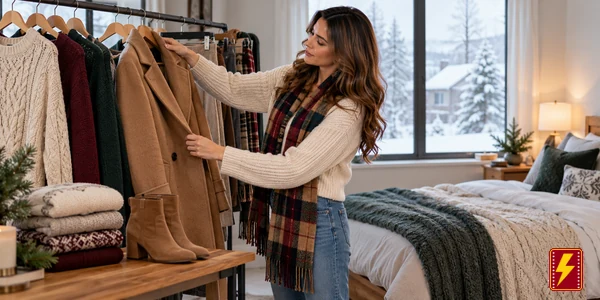
- Winter clearance is a price-versus-selection tradeoff: deeper markdowns usually arrive after the strongest sizes and styles begin disappearing.
- Buy coats, boots and exact-fit pieces earlier when selection matters; wait longer on flexible knitwear and accessories.
- Use wear-now, wear-next-year, replace, wait and skip logic rather than shopping by discount percentage alone.
- Three-outfit, cost-per-wear, fabric, alteration and return-policy tests help separate real wardrobe value from clearance impulse buying.
- The best winter-clearance piece is one you can use now, still want next winter and would choose even at a smaller discount.
Winter fashion clearance is one of the easiest seasonal sales to get wrong because the deepest markdowns arrive at the exact moment the best sizes and strongest pieces start disappearing.
That means January and late-winter fashion shopping is not just about waiting for the lowest price.
It is about deciding which pieces are worth buying now for the rest of this winter, which pieces are worth carrying into next winter, and which pieces should stay on the rail no matter how dramatic the markdown becomes.
This guide uses a simple framework: wear now, wear next year, wait, replace, skip.
Winter clothing really does get cheaper as spring approaches
That creates a real pricing reason, not just a marketing reason, for winter fashion to get cheaper.
Winter clearance is a tradeoff between a lower price and a smaller selection. Buy sooner when you need an exact coat size, boot fit or matching piece; wait longer when you can substitute styles and are shopping for next winter. The steepest markdown is not useful if the garment does not fit or you will not wear it.
Use the wear-now versus wear-next-year test
Before buying, decide which of these is true:
- wear now: you can use it several times before the season ends;
- wear next year: the style, fit and fabric are durable enough to store and reuse;
- replace: it fills a known wardrobe gap;
- wait: you are flexible and willing to risk the item selling out;
- skip: the discount is the main reason you want it.
Buy winter clothing earlier when fit matters
Coats, boots, trousers and fitted knitwear usually become riskier to wait on because size availability declines faster than prices.
Fashion & Apparel deals at DealsDasher can help compare current offers once you already know the wardrobe gap.
The deepest markdown is useless if your size is gone:
This is the most important winter-clearance tradeoff.
If a coat is 40% off in your size today and might be 60% off later, the extra 20% only matters if the coat still exists.
Use the regret-if-sold-out test
Ask: If this disappears tonight, will I actually care?
If yes, the current markdown may already be enough.
Use the regret-if-cheaper test
Ask: If this is cheaper next week, will I feel I bought too early?
If yes, you may be better waiting.
Coats are one of the best winter-clearance targets
A strong coat can deliver years of use, and winter clearance can make better fabrics or construction more affordable.
Outerwear & Jackets deals at DealsDasher can be useful when replacing a worn coat or filling a specific weather need.
Buy the coat for the climate, not the discount
Check insulation, wind resistance, water resistance, length, hood, pocket design, layering room and cleaning requirements.
Do not buy a heavy coat if your winter rarely needs one:
A bargain still has to match the climate you live in.
Classic outerwear usually carries well into next winter:
Pieces with repeat value include wool coats, simple puffers, trench-style winter coats, neutral parkas and clean quilted jackets.
Trend-heavy outerwear needs a bigger discount:
If the shape, print or trim is highly specific to one season, ask whether you will still want it next year.
Boots are another strong clearance category
Boots combine fashion, weather protection and fit, which makes them useful but risky to wait on too long.
Shoe deals at DealsDasher and Aldo Shoes offers can help when you are replacing a real footwear gap.
Buy boots by use case
Ask whether you need water resistance, traction, office wear, walking comfort, formal styling or snow performance.
Do not buy uncomfortable boots because the discount is deep:
Winter footwear is often worn for long periods and in difficult conditions.
Try boots with the socks you will actually wear
Fit changes when winter socks are thicker.
Knitwear is usually a lower-risk clearance purchase
Sweaters, cardigans and knit dresses can be easier to buy late because sizing is often more forgiving than fitted coats or boots.
Use fabric composition as the filter
Check wool content, cashmere blend, cotton, synthetics, stretch and care requirements.
Do not assume natural fiber always means better for your use:
A washable blend may suit daily wear better than a delicate fabric that needs special care.
Check pilling risk and surface condition:
Clearance knitwear may have been tried on frequently or handled heavily in-store.
Do not buy knitwear that already looks tired:
A markdown does not restore worn fabric.
Thermals can be good next-year buys
Base layers are less trend-sensitive than outerwear, and they store easily.
That makes them one of the safer late-season purchases when fit is known.
Buy thermals for function
Look at warmth, moisture management, fabric feel, fit under clothing and washability.
Do not buy three sets if you only need one:
Functional basics are easy to overbuy during clearance.
Scarves, gloves and hats can wait longer
Accessories generally have less fit risk and can be good candidates for deeper markdowns.
Generic accessories are better wait items than exact-size clothing
If you are flexible on color and design, late clearance can work well.
Fashion editors are still prioritizing versatile pieces in sale season
That is a useful editorial principle for winter clearance.
Buy pieces that connect to clothes you already own
A sale item becomes more useful when you can immediately name three outfits for it.
Use the three-outfit test
Before buying, build three realistic combinations using your current wardrobe.
If you cannot, the piece may create more shopping rather than solve a wardrobe need.
Do not buy a bargain that requires a new bag, shoes and trousers to work:
The real cost becomes much higher than the tag price.
Use the care-cost test too
A heavily discounted coat or knit can still be expensive to own if it needs specialist cleaning, delicate storage or frequent maintenance.
Before buying, check the care label and ask whether you are comfortable paying for that care repeatedly over the life of the garment.
Do not ignore alteration cost:
A clearance trouser that needs hemming or a coat that needs sleeve work can still be a good buy, but alterations belong in the real purchase price.
If the fit problem is structural rather than minor, the better decision is usually to leave it.
Luxury winter clearance needs even more discipline
Luxury Fashion deals at DealsDasher can be useful when the reduced piece is a long-term wardrobe purchase rather than a logo-driven impulse.
Use craftsmanship and repeat wear as the test
Look at fabric quality, lining, hardware, construction, repairability and how often you will realistically wear it.
Do not treat a high original price as proof of value:
Discount percentage and quality are separate questions.
Plus-size winter clearance needs an earlier buy point
Plus-size ranges can have fewer units per size, which means the best-fitting options may disappear earlier.
Plus Size Fashion deals at DealsDasher can be useful when fit and size availability are the priority.
Do not wait for the final markdown on a rare good fit:
If a coat, trouser or boot fits unusually well, selection may be more valuable than the last reduction.
Modest winter fashion can benefit from end-of-season layering deals
Modest Fashion deals at DealsDasher can help when you are looking for longline coats, knit layers, maxi silhouettes or covered winter basics.
Buy layering pieces for versatility:
A long coat, knit dress or wide-leg trouser that works across multiple settings has stronger next-year value than a highly specific occasion piece.
Do not let clearance push you into poor proportions:
Fit and layering still matter.
Men’s winter clearance follows the same rules
Coats, overshirts, knitwear, boots and thermals can all be strong end-of-season buys.
Prioritize pieces that work with an existing uniform:
If you already wear dark denim, chinos, office trousers or neutral knitwear, buy winter pieces that slot into that system.
Do not buy novelty outerwear because it is half price:
The item still needs to belong in your wardrobe.
Children’s winter clearance can save money, but sizing is harder
Buying ahead for next year can work, but growth is unpredictable.
Use flexible categories for children
Safer options may include hats, gloves, scarves, slightly forgiving outerwear and simple layers.
Be careful buying exact-size shoes a year ahead:
Foot growth can make the saving meaningless.
Do not overbuy next-year wardrobes for children:
The more precise the fit, the more uncertainty you are taking on.
Color is one of the easiest ways to accidentally buy a one-season piece
Trend colors can be useful when they already suit you.
Use the existing-wardrobe test
Ask whether the color already works with your coat, shoes, bags, trousers and knitwear.
Do not buy an unusual color only because the neutral version sold out:
Clearance leftovers are often leftovers for a reason.
Jewelry and accessories can refresh winter outfits without replacing clothing
Jewelry deals at DealsDasher can be useful when you want to update familiar winter outfits with a small repeatable detail.
Use accessories to extend existing clothes
One useful belt, scarf or pair of earrings can change several outfits.
Do not use accessories to rescue a bad clearance purchase:
If the garment itself does not work, return it.
Return policies matter more on deep clearance
Some end-of-season products are final sale or have shorter return windows.
Check return terms before trying to save the last 10%
Fit-sensitive purchases are riskier when returns disappear.
Do not trade away return rights for a tiny extra saving:
That is especially true for boots, coats, trousers and occasionwear.
Use the cost-per-wear test
A $120 coat worn 40 times costs $3 per wear.
A $30 novelty sweater worn twice costs $15 per wear.
Deep markdown does not automatically mean low cost per wear:
Use realistic repeat use.
Buy fabric and construction when the discount lets you trade up
Winter clearance can be a good time to move from a thin coat to better insulation, a weak knit to stronger fabric, a poor boot to a better outsole, or a temporary piece to a durable basic.
Do not turn every discount into a quality upgrade:
Only trade up where the product is actually used enough to justify it.
Use the remaining-winter test
Ask how many weeks of use are left in your climate.
If winter lasts into March, a January coat purchase may still deliver immediate value.
Use the next-winter test:
Ask: Would I be happy pulling this out next November?
If no, the discount needs to be extremely compelling.
Use the three-season test for lighter layers
Some pieces can work across autumn, winter and early spring.
That increases their usefulness.
Do not categorize every winter item as strictly seasonal:
Knitwear, boots, jackets and scarves often have wider windows.
Use the closet-space test
Before buying for next winter, decide where the item will live. Bulky coats, boots and thick knitwear have a storage cost. If adding the piece means overcrowding the wardrobe or buying more storage, include that friction in the decision.
Winter clearance has a predictable price-selection tradeoff
| Stage | Price | Selection | Best for |
|---|---|---|---|
| Early January | Good | Strong | Exact sizes, coats, boots |
| Mid/late January | Better | Thinner | Knitwear, flexible shoppers |
| February final clearance | Deepest | Weakest | Accessories, flexible basics |
Use the winter-clearance scorecard
| Question | Score 0–2 |
|---|---|
| Can I wear it several times this winter? | 0–2 |
| Would I wear it again next winter? | 0–2 |
| Does it fit properly today? | 0–2 |
| Can I style it with at least three things I own? | 0–2 |
| Are the return terms acceptable? | 0–2 |
The buy-now rule
Buy now when size matters, fit is unusually good, the garment fills a known gap, you can use it immediately and the price is already strong.
The wait rule
Wait when the item is generic, you are flexible on color, sizing is forgiving, inventory is still broad and the product is easy to substitute.
The next-year rule
Buy for next winter only when style is durable, fit is predictable, storage is easy, fabric quality is good and you would still choose it at a smaller discount.
The skip rule
Skip when the discount is the main attraction, fit is wrong, the item requires several new purchases to work, the fabric already looks tired or you cannot imagine wearing it next winter.
Clearance is only useful when the item survives the fit test:
The FTC notes that sale and clearance items can have different refund policies. Check the deadline and final-sale status before waiting for a deeper markdown, especially when the size or color you need is already becoming scarce.
Choose winter clothes that pass the fit and repeat-wear tests
Winter clearance works because retailers need to make room for spring, but that does not mean the deepest markdown is always the best deal.
The early part of clearance gives you better sizes and stronger selection. Later clearance gives you lower prices and more compromise.
Buy exact-fit coats and boots before selection collapses. Wait longer on scarves, gloves and flexible knitwear. Use clearance to trade up on quality where you already know the wardrobe need. Be cautious buying children’s exact-size clothing too far ahead. And never let a percentage-off sign talk you into a piece you would not choose at a smaller discount.
The best winter-clearance purchase is simple:
something you can wear now, still want next winter, and would have chosen even if the sale sign were smaller.
Frequently Asked Questions
When do winter clothes usually go on clearance?
Winter clearance commonly builds through January and can deepen into February as retailers make room for spring inventory.
Is January a good time to buy winter clothes?
Yes. January often combines meaningful markdowns with enough winter left for immediate use, although popular sizes can disappear quickly.
Should I wait until February for winter clothing?
Wait when you are flexible on size, color and exact style. Buy earlier when fit or selection matters.
What winter clothes are best to buy on clearance?
Classic coats, boots, knitwear, thermals and versatile accessories can be strong purchases when they match a real wardrobe need.
Should I buy winter clothes for next year?
Yes when fit is predictable, the style is durable, storage is easy and you would still choose the item without the deepest markdown.
Are winter coats cheaper after Christmas?
They often become more heavily discounted through January as retailers clear seasonal inventory, but the best sizes may sell out before final clearance.
How do I avoid buying bad clearance clothes?
Use fit, fabric, three-outfit, cost-per-wear and return-policy checks rather than relying on the discount percentage.
What is the biggest winter-clearance mistake?
Waiting for the lowest possible price on an item you genuinely need, or buying something you never wanted because the markdown became dramatic.