- Use a plan-prep-cook-store-repeat framework so kitchen purchases solve a proven cooking bottleneck instead of adding clutter.
- Buy for repeated tasks and total time saved, including setup and cleanup—not the number of functions on the box.
- Meal-prep containers should match real portion sizes, storage conditions and reheating needs rather than a one-size-fits-all set.
- USDA and FDA guidance supports refrigerating leftovers promptly, using most cooked leftovers within 3–4 days and reheating leftovers to 165°F.
- The best January kitchen deal is the tool or system that makes dinner happen more reliably, not the gadget with the biggest feature list.
January is full of kitchen gadgets promising to make healthy eating, meal prep and weeknight cooking easier.
Some genuinely help. Many simply move the problem from the kitchen counter to a cupboard.
The better question is not, “What kitchen gadget is on sale?” It is: what part of cooking keeps breaking down, and what is the smallest tool or system that fixes it?
This guide uses a practical framework: plan, prep, cook, store, repeat.
Plan the meals you actually make. Prep only the steps that save real time. Cook with tools that reduce friction rather than create cleanup. Store food safely. Then repeat the process in a way that still works after January motivation fades.
Meal prep works best when it solves a real weekday problem
People often think meal prep means cooking seven identical lunches on Sunday. That is only one version.
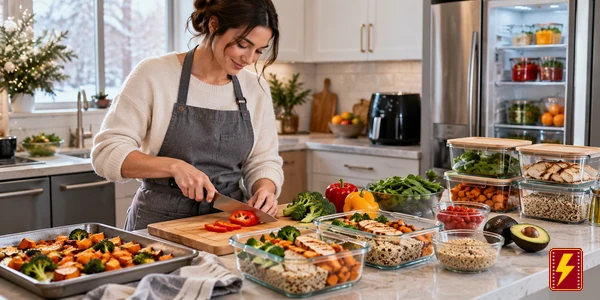
A more flexible approach can include chopping vegetables ahead, cooking one protein base, batching grains, prepping sauces, portioning snacks, assembling freezer meals, grouping ingredients by recipe, or pre-cooking two dinners and leaving the rest fresh.
Start with the friction, not the appliance
Write down what usually goes wrong around dinner time.
- no plan;
- missing ingredients;
- too much chopping;
- long cleanup;
- food spoiling before use;
- not enough containers;
- too many separate cooking steps;
- getting home too tired to start.
Different friction needs different solutions. If planning is the problem, a new air fryer will not fix it. If chopping is the bottleneck, a food processor might. If cleanup is the issue, one-pan meals may matter more than another appliance.
Before buying another kitchen gadget, name the problem you need to fix: weeknight prep taking too long, lunches costing too much, cleanup becoming a chore, or containers that leak or waste refrigerator space. Try a simpler meal plan or storage routine first. Buy equipment only when the same obstacle keeps coming back and a particular tool would solve it.
Use the plan-before-purchase rule
Before buying anything, choose three to five meals you already know you will cook. Then identify the repeated tasks inside them.
Examples include chopping onions, shredding vegetables, cooking rice, blending sauces, reheating lunches and freezing portions.
Buy for repeated tasks, not imagined future recipes. A gadget that saves five minutes on something you do four times a week is more useful than one that saves 20 minutes on a recipe you make twice a year.
Use the frequency test
Ask: How many times per month will I realistically use this?
That number should drive the purchase more than the discount percentage.
A food processor can be worth it when chopping is truly the bottleneck
Food processors can reduce time spent slicing, shredding, chopping and mixing. They are especially useful for people who regularly prepare vegetables, salsas, dips, shredded cheese, doughs or large-batch sauces.
Do not buy one if the cleanup takes longer than the knife work.
Use the dishwasher test
If the important removable parts are dishwasher safe and the machine stays accessible, the processor is more likely to become part of the routine.
Blenders should be bought for the output you make most
A blender can be useful for smoothies, soups, sauces, dressings, purees and frozen drinks.
Do not buy a high-powered blender only because it can do more. If you only make one smoothie twice a week, a simpler personal blender may be enough.
Multi-function appliances can reduce counter clutter when the functions are genuinely used
That can be useful when one system replaces several machines. But “4-in-1” has no value if you use one function.
Count the functions you will actually use, not the functions printed on the box.
Air fryers are useful when speed and small-batch cooking are the real need
An air fryer can help when you regularly cook small portions, reheated leftovers, vegetables, frozen foods or quick proteins.
Do not buy one simply because January lifestyle content tells you to eat healthier. The appliance should fit your actual cooking pattern.
Capacity matters more than headline features
A small basket may work well for one or two people. A larger household may need a dual-zone or larger-capacity model to avoid cooking in several rounds.
Cooking in three batches can erase the convenience advantage. Match capacity to household size and meal format.
Slow cookers can reduce evening decision fatigue
They are especially useful for stews, soups, braises, beans, shredded meats and batch meals.
Use them when morning prep is easier than evening prep. The real benefit is moving the work to a time when you have more energy.
Pressure cookers solve a different problem
They can reduce cooking time for beans, tough cuts, rice, soups and large batches.
Do not buy both a slow cooker and pressure cooker unless both fit distinct routines. Some multi-cookers already cover both jobs.
Use the overlap test before buying a new appliance
List the cooking tools you already own and what they do. Common overlap happens between air fryer and convection oven, blender and food processor, slow cooker and multi-cooker, stand mixer and food processor, or toaster oven and full-size oven.
Do not buy duplicate function unless the new tool fixes a real limitation. Faster cleanup, smaller batch size or better capacity can justify overlap.
Small tools often solve more friction than appliances
A sharp knife, cutting board, sheet pan, large mixing bowl or good peeler can improve meal prep without taking over the kitchen.
Use the five-minute-saved test. If a simple tool repeatedly saves five minutes and reduces annoyance, it can outperform a complex appliance in real value.
Containers are part of the cooking system, not an afterthought
Meal prep fails when food is cooked but difficult to store, portion or reheat.
Choose container size around actual portions. You may need a mix of single-serving lunch containers, larger family meal containers, small sauce tubs, freezer containers and snack containers.
Do not buy 30 identical containers because they are sold as a meal-prep set. Uniform sets look organized, but real meals have different portion sizes.
Glass versus plastic is a workflow decision
Glass can be useful for reheating, stain resistance, visibility and heavier home storage. Plastic can be useful for lighter lunches, transport, children’s meals and larger low-cost sets.
Check the manufacturer’s use limits. Microwave, freezer, dishwasher and oven suitability vary by product.
Do not assume every container can move from freezer to microwave or oven safely. Use the actual product instructions.
Airtight lids matter more than matching colors
Good seals help reduce leaks, protect texture, limit odors and keep fridge storage cleaner.
Food safety should shape the meal-prep schedule
The USDA says most cooked leftovers should be used within three to four days when refrigerated, and leftovers should be stored promptly in covered containers.
The FDA advises keeping the refrigerator at or below 40°F / 4°C and following the two-hour rule for perishable food left at room temperature.
Do not cook seven days of refrigerated meals by default:
If you prep for a full week, freeze later portions when appropriate instead of assuming everything should sit in the refrigerator until day seven.
Use a fridge-freezer split: Monday to Wednesday meals in the fridge, later-week meals in the freezer, and fresh components prepared midweek.
Reheating matters too
USDA guidance recommends reheating leftovers to 165°F / 74°C.
Do not build a meal-prep routine that ignores safe storage and reheating. Convenience should never depend on stretching food beyond sensible storage.
Use shallow containers for faster cooling:
USDA recommends shallow containers to help leftovers cool more rapidly before refrigeration.
Do not leave a large hot pot on the counter for hours. Divide food into smaller storage containers instead.
Meal prep does not have to mean full meals
Component prep can be easier to maintain. Examples include washed greens, roasted vegetables, cooked grains, boiled eggs, grilled chicken, sauces and chopped aromatics.
Component prep preserves flexibility. The same ingredients can become bowls, wraps, salads, stir-fries or side dishes.
Do not prep so rigidly that you hate the food by Thursday. Variety matters.
Use one anchor protein, one grain and two vegetables
This can create multiple meals without requiring five completely separate recipes.
Batching works best when one ingredient appears more than once. Roasted vegetables, for example, can work in dinner, lunch bowls and wraps.
Do not duplicate prep just because recipes are written separately. Combine overlapping tasks.
Ingredient bins can reduce evening decision friction
That reduces searching and makes the next meal obvious.
Use the method without overbuying storage. You may already own trays, baskets or containers that can do the same job.
Do not organize the refrigerator before editing the food:
Throw out spoiled items, combine duplicates and use older ingredients first.
Meal kits can be a bridge when planning is the real problem
Meal kit options can reduce recipe selection, ingredient shopping, portion planning and waste from unusual ingredients, provided the total cost and portions fit your household.
But they are not automatically cheaper. Compare cost per serving with your normal grocery habits.
Use meal kits strategically for very busy weeks, learning new recipes, reducing takeout or couples with predictable portions.
Do not judge meal kits only against groceries:
Compare them with the realistic alternative. If the real alternative is restaurant delivery three nights a week, a meal kit may still reduce total spending.
Grocery delivery can solve the shopping bottleneck
If the problem is getting to the store after work, grocery delivery or pickup may improve consistency. Compare fees and substitutions before treating it as a money-saving option.
Use it when it prevents takeout or wasted time, but include delivery fees, service fees, tips, membership cost and price markups.
Do not call convenience free. Price the time saving honestly.
Use kitchen sales to replace weak tools, not create a new identity
Appliance deals at DealsDasher and Long Eaton Appliance offers can help compare equipment when a specific cooking bottleneck is already clear.
January is not the only time kitchen appliances go on sale:
Current retail coverage shows kitchen-appliance promotions recurring across major sale events throughout the year.
That means there is no need to force a January purchase simply because “New Year, new routine” marketing is everywhere.
Use the 30-day proof rule for expensive gadgets
If you think you need a major appliance, first prove the cooking habit for a month using simpler tools.
Batch cook before buying a large freezer. Make smoothies regularly before buying a premium blender. Cook vegetables often before buying a large air fryer. Bake weekly before buying a stand mixer.
Do not buy capacity before the habit exists. Large appliances consume money and space.
Counter space is part of the price
Before buying, measure width, depth, height, cabinet clearance and power outlet location.
If the appliance has to be unpacked every time, usage may collapse. Convenience tools work best when setup is easy.
Use the cleanup-time test
Ask how long it takes to assemble, use, wash, dry and put away.
A gadget that saves prep time but doubles cleanup may not reduce total friction. Measure the whole process.
Do not buy a complicated tool for a simple meal:
A pan, knife and cutting board may still be the fastest setup.
Use the one-pot and sheet-pan strategy before buying more equipment. Changing the recipe format can reduce cleanup without any purchase.
Freezer storage can be more valuable than another appliance
Freezing portions can extend the useful life of batch cooking and reduce the pressure to eat the same meal repeatedly.
Label freezer meals clearly with meal name, date, portion count and reheating instructions if useful.
Do not turn the freezer into anonymous containers. If you cannot identify it, you are less likely to eat it.
Use first-in, first-out at home
Move older prepared food forward and newer food behind it.
This reduces food waste without requiring new technology. A marker and a date can solve more than another organizer.
Use the pantry-before-cart test
Before shopping, check rice, pasta, beans, canned goods, frozen vegetables, sauces and spices.
Build at least one meal around what is already open. That keeps food rotation moving.
Do not meal prep by buying an entirely new pantry every Sunday. Use what you already own.
Cost per serving is more useful than grocery-ticket size
A larger grocery bill can still produce cheaper meals when it covers more servings.
For one week, compare grocery spending, takeout spending and food discarded.
Do not judge meal prep only by grocery spend. The real benefit may be less takeout and less waste.
Use batch cooking where scale actually helps
Good candidates include soups, curries, chili, rice, beans, roasted vegetables, sauces and braised dishes.
Do not batch delicate food that degrades quickly. Some dishes are better cooked fresh.
Use two prep sessions if Sunday becomes exhausting
A Sunday plus Wednesday rhythm can be more sustainable than one huge weekly session.
Meal prep should reduce workload, not move six hours of work to Sunday. Keep the routine proportional.
Use the 60-minute cap when starting
For the first few weeks, stop after roughly an hour. See what made the biggest difference.
Then add only what earned its place. This prevents the routine from becoming a project.
Use the kitchen-friction scorecard
| Question | Score 0–2 |
|---|---|
| Can I name the exact cooking bottleneck? | 0–2 |
| Will this tool be used at least several times a month? | 0–2 |
| Does it fit the available counter/storage space? | 0–2 |
| Does it reduce total time including cleanup? | 0–2 |
| Does it replace a real takeout, waste or prep problem? | 0–2 |
The buy-now rule
Buy when the cooking bottleneck is proven, the tool solves that exact problem, the storage is already planned and the current price is strong.
The start-smaller rule
Start smaller when the habit is new, the appliance is expensive or you are not sure which part of the routine actually needs help.
The container rule
Buy containers after you know your portion sizes, fridge space and whether you need fridge, freezer, microwave or transport use.
The meal-kit rule
Use meal kits when they reduce planning or takeout enough to justify the cost.
The skip rule
Skip the purchase when the gadget solves no repeated task, duplicates another appliance, creates worse cleanup, has nowhere convenient to live or is attractive mainly because of the January discount.
Meal prep only works when storage is safe
The USDA recommends refrigerating perishable leftovers within two hours, using shallow containers for faster cooling and reheating leftovers to 165°F. Container capacity and freezer space therefore belong in the buying decision before another appliance does.
Buy the simplest tool that fixes your cooking bottleneck
New Year kitchen shopping works best when the purchase comes after the cooking problem is clear.
The most useful meal-prep system may be a better container, a sharper knife, a freezer routine, one batch-cooked base or a simpler grocery plan.
It may also be an appliance—but only when that appliance removes repeated friction from something you already do.
Plan first. Prep only the steps that matter. Cook with tools that reduce total effort. Store food safely. Repeat the parts that actually make weekdays easier.
The best January kitchen deal is not the gadget with the most functions.
It is the one that makes dinner happen more reliably.
Frequently Asked Questions
What kitchen gadgets are most useful for meal prep?
The most useful tools depend on the bottleneck. Common high-value options include a sharp knife, good cutting board, food processor, blender, sheet pans, containers and a slow cooker or multi-cooker when those match your routine.
Are glass or plastic containers better for meal prep?
Glass is useful for visibility, reheating and stain resistance, while plastic is lighter and easier to transport. Check each product’s microwave, freezer, dishwasher and oven limits.
How long do meal-prep leftovers last in the refrigerator?
USDA guidance says most cooked leftovers should generally be used within three to four days when refrigerated properly.
Can I meal prep for seven days?
You can prep for a week, but later portions may need to be frozen rather than kept refrigerated for the full seven days.
Do meal-prep containers need to be airtight?
A good seal is useful for reducing leaks, protecting texture and keeping refrigerator storage cleaner.
Are meal kits cheaper than groceries?
Not always. Compare cost per serving, but also compare the realistic alternative—especially if meal kits replace frequent takeout or reduce wasted ingredients.
Should I buy an air fryer for meal prep?
Only if fast small-batch cooking, reheating or vegetable and protein prep are tasks you will use regularly. Match capacity to household size.
What is the biggest New Year kitchen-shopping mistake?
Buying appliances before identifying the actual cooking problem, which can add clutter without making meal planning, prep or cleanup any easier.