- January is a strong fitness-sale month, but the best purchase is the one that removes friction from a routine you can realistically keep.
- Use a routine-friction-space-progression-repeat framework before buying treadmills, bikes, dumbbells or other home-gym equipment.
- Measure operating space, delivery requirements and long-term storage before comparing prices on large machines.
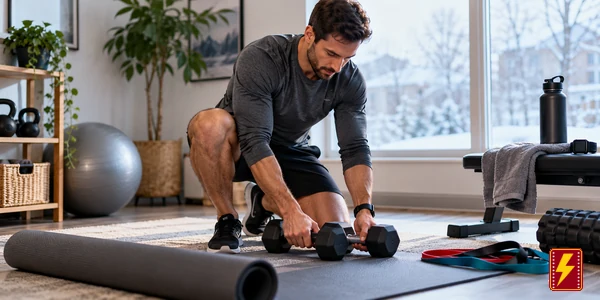
- Start smaller when the habit is new; adjustable dumbbells, resistance bands, mats and a bench can support broad progression without a full home gym.
- Use the January discount to buy the right tool more cheaply, not to create a more ambitious resolution.
January fitness deals are useful because retailers know millions of people are thinking about exercise at exactly the same time.
That does not mean every treadmill, dumbbell set or smartwatch on sale is a smart buy.
The best January fitness purchase is the one that removes a real barrier from a routine you are likely to keep.
This guide uses a simple framework: routine, friction, space, progression, repeat.
Start with the exercise routine you can realistically maintain, identify the friction that stops you doing it, buy only what removes that friction, make sure the equipment fits your space, and choose products that still make sense once the New Year motivation wears off.
January really is a strong fitness-shopping month
The reason is simple: retailers know demand spikes when health and exercise goals move to the top of people’s January lists.
Demand is unusually high in 2026:
The Health & Fitness Association says 56% of U.S. adults planned to set personal goals for 2026, and 54% of those goal-setters intended to focus on health, fitness and exercise.
That works out to roughly 82 million Americans prioritizing fitness-related goals.
The association also estimates Americans plan to spend about $60 billion in 2026 on health, fitness and exercise goals.
High demand creates both deals and bad decisions:
January is a good time to shop because retailers compete for that demand.
It is also a dangerous time to shop because motivation can temporarily make ambitious equipment look more realistic than it is.
Start with the routine before the product
Write down the routine you can actually imagine repeating in March.
Examples:
- three 30-minute strength sessions per week;
- daily walking;
- two home cardio sessions plus weekend outdoor activity;
- mobility work every evening;
- two gym visits and one home session.
Do not buy for the person you hope to become:
Buy for the routine you can realistically start now.
Use the friction test
Ask:
What makes the current routine harder than it needs to be?
Common friction points include:
- gym travel time;
- bad weather;
- lack of weights;
- no space for floor work;
- poor footwear;
- equipment setup taking too long;
- not knowing what workout to do.
Buy the item that removes the friction:
If weather stops your walks, a walking pad may solve a real problem.
If gym travel kills consistency, adjustable dumbbells may help.
If equipment clutter is the issue, a foldable bench may make more sense than adding more loose gear.
Home strength training can start smaller than most people think
A useful home strength setup does not need a full rack on day one.
It may start with:
- adjustable dumbbells;
- resistance bands;
- bench;
- mat;
- door-anchor system.
Core Home Fitness deals and Flybird Fitness offers can be useful when you already know strength training is part of the plan.
Use progression as the buying filter
Ask whether the equipment still works when you become stronger.
A very light fixed dumbbell may be cheap today but become useless quickly.
Adjustable equipment can reduce repeat buying
It can also reduce storage needs when several weight levels replace multiple individual pieces.
Do not pay for adjustment features you hate using:
Some systems are fast. Some are fiddly.
If changing the weight becomes annoying, the equipment can add friction instead of removing it.
Large cardio equipment needs a space test before a price test
Treadmills, ellipticals, rowing machines and stationary bikes can be heavily promoted in January.
But the first question is not whether the price is low.
It is whether the machine has a permanent, usable place in the home.
Measure the operating footprint, not only the storage footprint
Check:
- length;
- width;
- ceiling clearance;
- space behind the machine;
- door swing;
- power outlet;
- noise below or beside the room.
Do not plan to move a heavy machine every day unless you have tested that plan:
Folding does not automatically mean convenient.
Walking pads can be useful for a narrow job
They make the most sense when your goal is to increase low-intensity walking indoors, especially during bad weather or work-from-home days.
Do not buy a walking pad expecting it to replace every form of training:
It is a tool for walking, not a complete fitness system.
Exercise bikes can work well for predictable cardio
A bike may be easier to use consistently when you want:
- low-impact cardio;
- indoor training;
- short sessions;
- repeatable intensity.
Check adjustability before buying
Seat height, handle position and resistance range determine whether the bike actually fits the user.
Rowing machines need technique commitment
A rowing machine can provide full-body conditioning, but poor technique can make the experience uncomfortable or ineffective.
Do not buy a machine because one workout video made it look efficient:
Make sure the movement itself suits you.
Benches are often more useful than they look
A stable bench can expand dumbbell training into:
- presses;
- rows;
- split squats;
- step-ups;
- supported exercises.
That makes it a strong second purchase after weights for many home setups.
Check load capacity and stability
A lower price is not worth it if the bench rocks, flexes or becomes uncomfortable under load.
Resistance bands are one of the lowest-risk January purchases
They are:
- cheap;
- compact;
- portable;
- useful for strength and mobility;
- easy to combine with other equipment.
But cheap bands still need quality checks:
Look for:
- secure handles;
- clear resistance ratings;
- good anchor design;
- damage inspection guidance;
- replacement availability.
Do not keep using visibly damaged bands:
Stretching equipment should be inspected because worn material can fail suddenly.
Mats are simple but worth choosing properly
For mobility, yoga or floor exercise, check:
- thickness;
- grip;
- length;
- cleaning;
- floor type.
Do not buy the thickest mat automatically:
Very soft mats can feel unstable for standing movements.
Activewear should solve movement and comfort problems
Activewear deals at DealsDasher can be useful when your current clothing is genuinely limiting comfort, temperature control or movement.
Buy activewear for the activity
Running, lifting, yoga and outdoor walking do not always need the same clothing.
Do not replace an entire workout wardrobe in January:
Start with the weak point:
- supportive top;
- comfortable training bottoms;
- weather layer;
- socks;
- shoe.
Shoes deserve more scrutiny than most fitness accessories
The best shoe depends on the actual movement.
Running shoes, lifting shoes, court shoes and walking shoes solve different problems.
Do not buy a shoe because it matches the gym clothes:
Fit, use and comfort matter more.
Wearables can help when you already know what you want to track
A tracker may help with:
- steps;
- heart rate;
- workout duration;
- sleep;
- training consistency.
Do not buy a smartwatch because more data feels like more progress:
Tracking only helps when the data changes behavior.
Use the metric test
Ask:
What decision will this measurement help me make?
If you cannot answer, the feature may not matter.
Fitness subscriptions should be judged by actual weekly use
Apps, classes and connected-machine memberships can be excellent value when they reduce planning friction.
Use the sessions-per-month test
If the subscription costs $30 per month and you use it 12 times, that is $2.50 per session.
If you use it twice, it is $15 per session.
Do not pay annually before testing the habit:
A monthly trial can reveal whether you like:
- the coaching style;
- workout length;
- music;
- difficulty;
- equipment requirements.
Supplements should not be the first fitness purchase
Fitness Supplement deals at DealsDasher can be useful when a specific product already fits your nutrition plan, but a supplement should not replace the training routine itself.
Do not use January sales to create a shelf of unused powders:
Buy repeat-use products only when you already know:
- why you use them;
- how often;
- how they fit your diet;
- whether the serving size is realistic.
Large equipment should pass a six-month test
Ask:
Would I still want this machine in July?
If the answer depends on being highly motivated in January, the purchase is not ready.
Use the boredom test
Think about whether the equipment supports enough variety to remain useful.
A bench and adjustable dumbbells can create dozens of exercises.
A single-purpose machine may offer fewer options.
Single-purpose equipment is not automatically bad:
It can be excellent when you love that exact movement.
Buy for preference, not theoretical efficiency:
The best exercise is the one you are willing to repeat.
Do not buy a rower because experts say rowing is efficient if you hate rowing:
Adherence matters more than theoretical completeness.
Use the setup-time test
Ask how long it takes to start the workout.
Equipment that requires moving furniture, finding accessories and assembling parts can quietly reduce consistency.
Reduce the number of steps between you and the workout
Good home-gym design makes the first five minutes easy.
Storage matters more than people expect
Small equipment can still become clutter.
Plan where:
- dumbbells;
- bands;
- mat;
- shoes;
- charger;
- accessories
will live when they are not being used.
Do not turn the living room into permanent equipment overflow:
A routine becomes easier when storage is part of the setup.
January sales can justify buying better quality, not more quantity
Use the discount to move one level up on the item you need.
For example:
- more stable bench;
- better dumbbell mechanism;
- quieter treadmill;
- higher-quality mat;
- more supportive activewear.
Do not use the same discount to buy three mediocre products:
One reliable tool can support the routine longer.
Compare warranty and service before large purchases
For expensive machines, check:
- frame warranty;
- parts;
- labor;
- return shipping;
- assembly;
- service availability.
Delivery can erase part of a fitness deal
Large equipment may involve:
- curbside delivery;
- room-of-choice fees;
- assembly;
- stairs;
- return freight.
Use delivered cost, not product price:
A cheaper treadmill with expensive delivery and assembly may not actually be cheaper.
Open-box fitness equipment can appear after the holidays
Check what was actually returned:
For an open-box machine, ask whether:
- all parts are present;
- assembly has occurred;
- cosmetic damage exists;
- warranty is intact;
- returns are still allowed.
Do not buy missing-parts equipment unless replacements are confirmed:
The discount can disappear quickly.
Use price history for expensive equipment
January is a strong fitness-sale month, but that does not mean every price is an annual low.
Compare the exact model
Look at:
- normal recent selling price;
- previous holiday pricing;
- included accessories;
- bundle changes.
Do not trust the crossed-out MSRP alone:
The real comparison is what the product normally sells for.
Use a minimum viable home gym
For many people, a practical starter setup could be:
- mat;
- adjustable dumbbells;
- resistance bands;
- bench if space allows.
Add cardio only when the routine needs it
Walking outdoors, stairs or gym cardio may already solve that part.
Do not duplicate what you already have access to:
If your building has a treadmill room, another treadmill may not be the best use of money.
Gym membership versus home equipment is a friction comparison
Think about:
- travel time;
- crowding;
- equipment variety;
- coaching;
- privacy;
- space;
- upfront cost.
There is no universal cheaper option:
The better choice is the one you will actually use.
Use cost per session rather than monthly price alone
A $600 setup used 150 times costs $4 per session before maintenance.
A cheaper product used ten times can be far more expensive per use.
Do not make cost-per-use projections based on perfect motivation:
Use a conservative estimate.
Use the three-month proof rule for very expensive upgrades
If you are considering a major machine, prove the habit for several weeks with a cheaper version of the activity first.
Examples:
- walk consistently before buying a premium treadmill;
- use gym cycling before buying a connected bike;
- train with dumbbells before building a full rack.
January is not the deadline:
If the purchase is not ready, you can wait.
Fitness equipment goes on sale again.
Use the January fitness scorecard
| Question | Score 0–2 |
|---|---|
| Does this support a routine I already understand? | 0–2 |
| Does it remove a real friction point? | 0–2 |
| Does it fit the space without daily hassle? | 0–2 |
| Can it progress with me for at least six months? | 0–2 |
| Would I still buy it without New Year motivation? | 0–2 |
The buy-now rule
Buy when:
- the routine already exists;
- the equipment removes friction;
- the space is measured;
- the delivered price is good;
- the product can grow with you.
The start-smaller rule
Start smaller when:
- the routine is new;
- space is uncertain;
- you have not tried the movement;
- the equipment is expensive;
- motivation is doing most of the work.
The skip rule
Skip the purchase when:
- you cannot explain the weekly routine;
- the machine has nowhere practical to live;
- it duplicates equipment you already access;
- the subscription cost is unclear;
- the discount is the main reason you want it.
Buy around the habit you can actually repeat:
ACSM’s 2026 fitness-trend survey ranks wearable technology first and mobile exercise apps fourth. The useful lesson for a January purchase is not to chase the trend: choose equipment, software or tracking only when it supports a routine you will still use after the resolution period.
Choose equipment you can use consistently
January is genuinely one of the better months to shop for fitness equipment.
That makes January a good buying window, not a buying obligation.
Start with the routine. Find the friction. Measure the space. Choose equipment that can progress with you. Then use the January discount to buy the right tool more cheaply.
The strongest fitness purchase is not the one that looks most ambitious on January 2.
It is the one you are still using in June.
Frequently Asked Questions
Is January a good time to buy fitness equipment?
Yes. January is widely recognized as a strong promotional period for treadmills, ellipticals, weights, trackers and other fitness gear.
What fitness equipment should a beginner buy first?
Start with equipment that matches a simple routine, such as a mat, resistance bands, adjustable dumbbells and possibly a bench if space allows.
Should I buy a treadmill in January?
Only if indoor walking or running is already a realistic part of your routine and you have measured the operating space, noise and delivery requirements.
Are adjustable dumbbells worth it?
They can be especially useful when you need several weight levels but have limited storage, provided the adjustment system is quick and durable.
Should I buy a fitness tracker?
Buy one when you know what metric you want to use and how it will change your behavior. More data by itself does not guarantee better consistency.
Is a gym membership cheaper than a home gym?
It depends on usage, equipment needs, travel time, available space and how long you keep the routine. Compare cost per session rather than monthly price alone.
Should I buy fitness supplements during January sales?
Only when a specific product already fits your nutrition plan. Supplements should not be the first purchase supporting a new exercise routine.
What is the biggest January fitness-shopping mistake?
Buying equipment for a resolution before proving the routine, measuring the space or understanding how often the product will actually be used.